
What is the function of the outer three wall layers of the microsporangium?
Answer & explanation
Correct answer: option 1
The correct answer is Option (1) → Protection and dehiscence
In a transverse section, a microsporangium is surrounded by four wall layers: the epidermis, the endothecium, the middle layers and the tapetum. The outer three layers and the innermost tapetum do different jobs.
Option (1) Protection and dehiscence — Correct. The epidermis, endothecium and middle layers protect the microsporangium. They also help the anther to split open (dehiscence) so that the pollen grains are released.
Option (2) Nourishment of pollen grains — Incorrect. Nourishing the developing pollen grains is the work of the tapetum, the innermost wall layer. Its cells have dense cytoplasm and often more than one nucleus.
Option (3) Production of pollen sacs — Incorrect. The wall layers do not make pollen sacs. The microsporangia themselves develop further and become the pollen sacs.
Option (4) Formation of sporogenous tissue — Incorrect. The sporogenous tissue is a group of compact cells in the centre of a young microsporangium, inside the wall layers. Its cells divide by meiosis to form microspore tetrads.
NCERT Extract:
Stamen, Microsporangium and Pollen Grain – “… Structure of microsporangium: In a transverse section, a typical microsporangium appears near circular in outline. It is generally surrounded by four wall layers (Figure 1.3b)– the epidermis, endothecium, middle layers and the tapetum. The outer three wall layers perform the function of protection and help in dehiscence of anther to release the pollen. The innermost wall layer is the tapetum. It nourishes the developing pollen grains.”
Stamen, Microsporangium and Pollen Grain – “… The microsporangia develop further and become pollen sacs.”
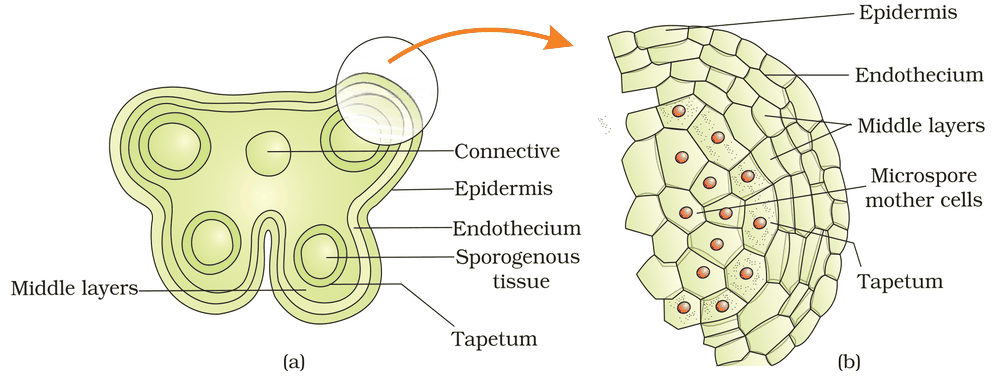
Figure 1.3 (a) Transverse section of a young anther; (b) Enlarged view of one microsporangium showing wall layers