
CUETMOCK
  • Pricing
  • Mentors
Log inStart freeStart free mocks→

First test, then trust

Try a free CUET mock test.

Join 5,00,000+ students who rehearsed exam day on the exact NTA screen before sitting CUET. On the web and on Android.

Start free mocks →Get the Android app
CUETMOCK

India's #1 CUET Mock Test Platform. Original NCERT-based questions on the exact NTA exam screen — trusted by 5,00,000+ students since CUET 2022.

Get it onGoogle PlayScan to download the CUETMOCK app

Mock tests

  • CUET mock test series
  • Commerce mocks
  • Humanities (Arts) mocks
  • Science mocks
  • Languages & GAT mocks
  • Free practice questions
  • Pricing

Resources

  • CUET exam guide
  • CUET syllabus
  • Universities accepting CUET
  • Expert blogs
  • News & notifications
  • Webinars & counselling
  • CUET score calculator
  • How we estimate your rank
  • FAQs

Company

  • About us
  • Our leadership & team
  • Our toppers
  • Mentors
  • For schools
  • Contact us
  • Terms
  • Privacy
  • Refund policy

Talk to us

+91 7696 6630 56info@cuetmock.comWhatsApp us

Our other platforms

  • JEE Mock — For IIT-JEE aspirants
  • NEET Mock — For NEET aspirants

Newsletter

Exam updates, study material and offers — no spam.

© 2026 NYC Ventures Pvt. Ltd.

701-702, Royal Business Park, Zirakpur, Punjab - 140603

  • Terms of use
  • Privacy policy
  • Refund policy
  • Contact us

iCUETMOCK is an independent preparation platform, not affiliated with the National Testing Agency (NTA). Always check exam details on the official NTA website.

  • Home
  • Mock tests
  • CUET guide
  • Pricing
  • Log in
Home/Practice questions/Chemistry
ChemistryInorganic: D and F Block Elements

Which of the following ions will exhibit colour in aqueous solution?

Which of the following ions will exhibit colour in aqueous solution?

Answer & explanation+

Correct answer: option 2

The correct answer is Option (2) → Ti3+ (Z = 22)

An ion is coloured in water when it has a partly filled d subshell: a d electron absorbs visible light and is excited to a higher energy d orbital, and the solution shows the complementary colour. An ion with no d electrons, or a completely filled subshell, has no such transition and is colourless.

  • Configuration of Ti: Ti (Z = 22) is [Ar]3d24s2.

  • Ion formed: losing the two 4s electrons and one 3d electron gives \( \ce{Ti^3+} \): [Ar]3d1.

  • d subshell: 3d1 is partly filled, so a d–d transition is possible; aquated \( \ce{Ti^3+} \) is purple.

Why the other options are incorrect

Option (1) La3+ (Z = 57) — Incorrect. La (Z = 57) is [Xe]5d16s2; \( \ce{La^3+} \) is [Xe], with no d or f electrons, so it is colourless.

Option (3) Lu3+ (Z = 71) — Incorrect. Lu (Z = 71) is [Xe]4f145d16s2; \( \ce{Lu^3+} \) is [Xe]4f14, a completely filled 4f subshell and no partly filled d or f subshell, so it is colourless.

Option (4) Sc3+ (Z = 21) — Incorrect. Sc (Z = 21) is [Ar]3d14s2; \( \ce{Sc^3+} \) is 3d0, with no d electron to excite, so it is colourless.

NCERT (2026-27 edition):
4.3.10 Formation of Coloured Ions – “When an electron from a lower energy d orbital is excited to a higher energy d orbital, the energy of excitation corresponds to the frequency of light absorbed (Unit 5). This frequency generally lies in the visible region. … In aqueous solutions where water molecules are the ligands, the colours of the ions observed are listed in Table 4.8.”

Table 4.8: Colours of Some of the First Row (aquated) Transition Metal Ions
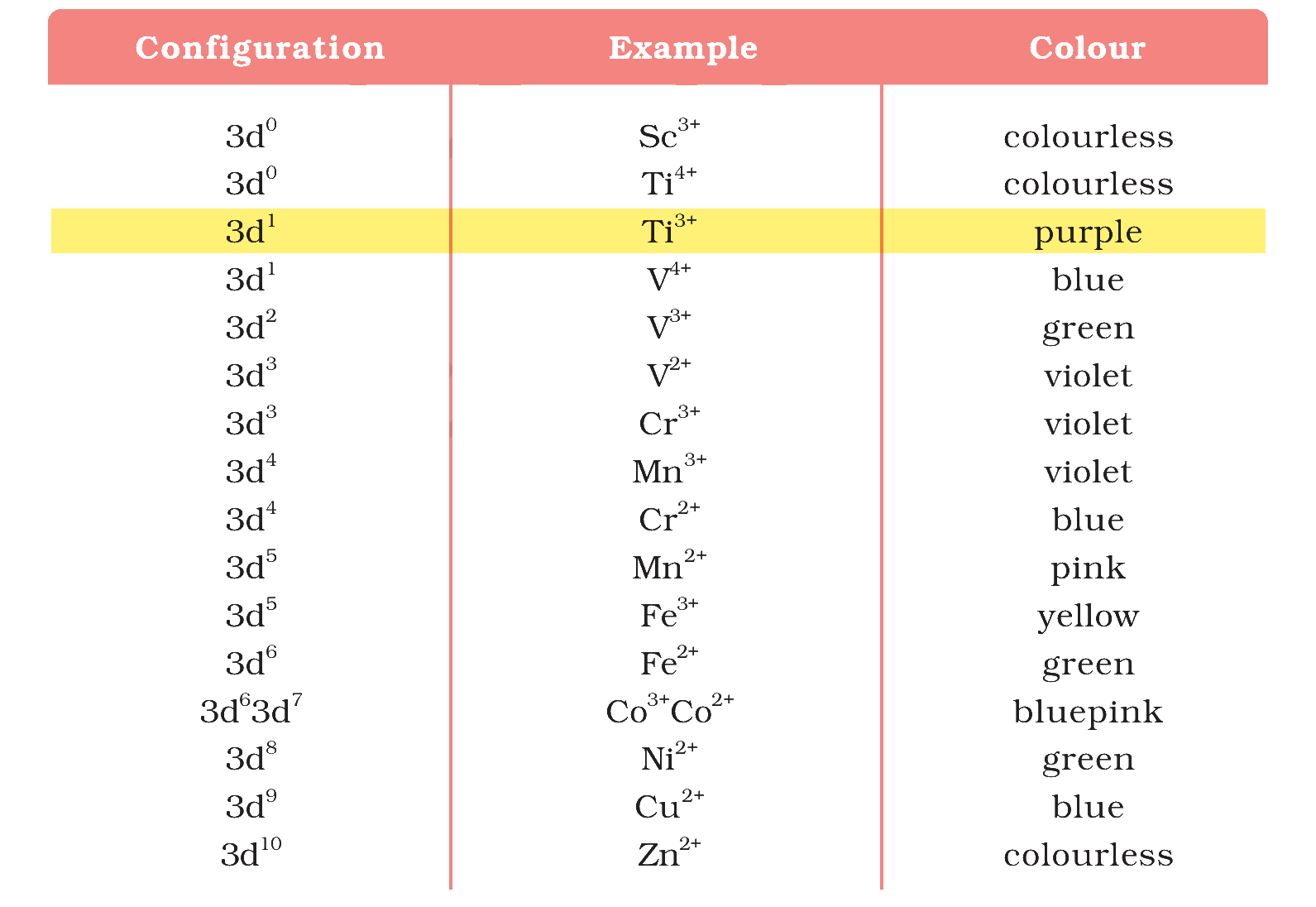
Table 4.8

Advertisement

Practise more on Inorganic: D and F Block Elements

Chapter-wise mocks on the real NTA exam screen, with solutions and your rank. Your first mocks are free.

Start free mocks →

Advertisement

Next questions

  1. When did Anand Coomaraswamy coined the term 'Rajput Paintings'?Fine Arts · The Rajasthani Schools of Painting
  2. Which of the following is not a Cultural Consequence of Globalisation?Political Science · Contemporary World Politics: Globalisation
  3. Which of the following is not a public sector enterprise?Economics · Indian Economic Development: Liberalisation, Privatisation and Globalisation - An Appraisal
  4. Sentences of a paragraph are given below in jumbled order. Arrange the sentences in the correct order to form a meaningful and coherent par…English · Arrange in Meaningful Sequence
  5. Select the dice that can be formed by folding the given sheet along the lines. Question figure:General Aptitude Test · Verbal Reasoning
  6. In young's double slit experiment, the separation between slits is trippled and distance between the slits is made one third. The fringe wi…Physics · Wave Optics
  7. How many of the following are secondary cells?Leclanche cell (dry cell), mercury cell, lead storage battery, nickel-cadmium cellChemistry · Physical: Electro Chemistry
  8. Which factors affect the rate of a chemical reaction?(A) Temperature(B) Pressure(C) Product concentration.(D) Reactant Concentration(E) Sha…Chemistry · Physical: Chemical Kinetics
  9. The reactance of a circuit is zero. It is possible that the circuit contains:A. an inductor and a capacitorB. an inductor but no capacitorC…Physics · Alternating Current
  10. Fill in the blank with a suitable Article if necessary : I don't think ________ mother is home yet.English · Grammar: Articles