OUTPUT AND EMPLOYMENT
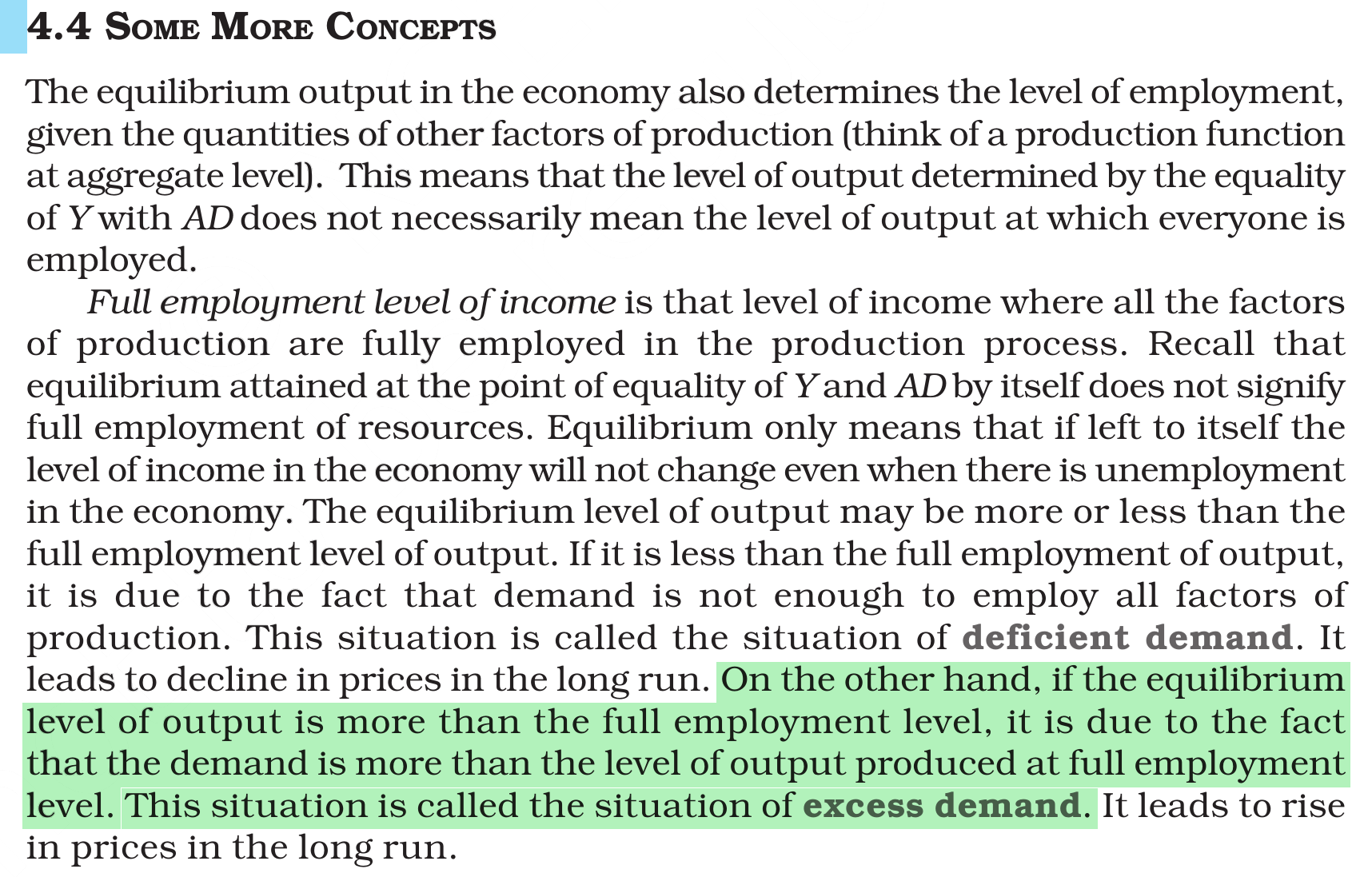
The equilibrium output in the economy also determines the level of employment, given the quantities of other factors of production (think of a production function at aggregate level). This means that the level of output determined by the equality of Y with AD does not necessarily mean the level of output at which everyone is employed. Full employment level of income is that level of income where all the factors of production are fully employed in the production process. Recall that equilibrium attained at the point of equality of Y(Income) and AD by itself does not signify full employment of resources. Equilibrium only means that, if left to itself, the level of income in the economy will not change even when there is unemployment in the economy. The equilibrium level of output may be more or less than the full employment level of output. If it is less than the full employment of output, it is due to the fact that demand is not enough to employ all factors of production. This situation is called the situation of deficient demand. It leads to a decline in prices in the long run. On the other hand, if the equilibrium level of output is more than the full employment level, it is due to the fact that the demand is more than the level of output produced at full employment level. This situation is called the situation of excess demand. It will lead to a rise in prices in the long run.
Excess demand is the situation where .......
Answer & explanation
Correct answer: option 3
The correct answer is Option (3) → Demand is more than output level at full employment level.
The economy can produce only so much when all its factors of production are at work; that is the full employment level of output. When buyers together want more than this, demand is more than the level of output produced at full employment, and output cannot rise to meet it. This situation is called excess demand. With no more output to be had, the extra demand pushes up the general level of prices in the long run.
Why the other options are incorrect
Option (1) Output level is less than the full employment level. — Incorrect. Equilibrium output below the full employment level means demand is not enough to employ all factors of production; that is the opposite case, deficient demand, which lowers prices in the long run.
Option (2) Output level is equal to the full employment level. — Incorrect. When equilibrium output equals full employment output, demand is neither more nor less than what the economy can produce, so there is no excess demand.
Option (4) Output level is marginally increasing. — Incorrect. A small rise in output says nothing about demand going beyond the full employment level, which is what excess demand means.
Note: The passage of this question is taken from the section ‘Some More Concepts’ of the chapter ‘Determination of Income and Employment’ of the NCERT book; the heading ‘Output and Employment’ was added in the paper. Read the short closing sections of every chapter too.
NCERT (2026-27): Introductory Macroeconomics — Chapter 4: Determination of Income and Employment
|