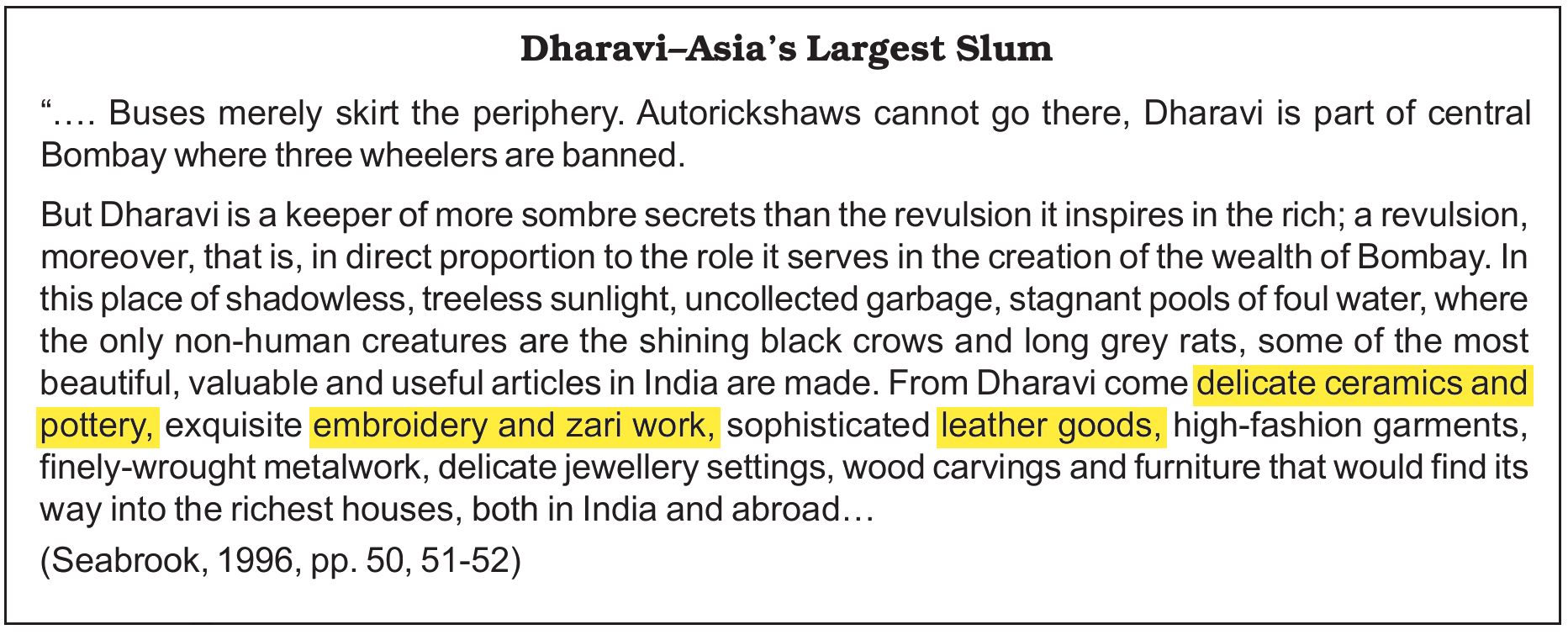
Dharavi area of Mumbai is an example of which industry?
Answer & explanation
Correct answer: option 4
The correct answer is Option (4) → Household/cottage industry
A household or cottage industry is the smallest manufacturing unit, run by artisans in their own homes.
Option (1) Large scale industry — Incorrect. Large scale manufacturing needs a large market, advanced technology, assembly-line mass production and large capital. Dharavi’s pottery and embroidery are crafts, not mass production.
Option (2) Village industry — Incorrect. Dharavi is part of central Mumbai, not a village. By size, industries are household (cottage), small scale and large scale.
Option (3) Mineral-based industry — Incorrect. Mineral based industries, such as iron and steel or aluminium, use minerals as raw material. Dharavi makes ceramics, embroidery, leather goods and garments.
Option (4) Household/cottage industry — Correct. Pottery, embroidery, leather goods and jewellery settings are made in Dharavi. Such goods, made with simple tools, are typical products of household industries.
Note: The given answer is as per the official NTA Answer Key. The book does not call Dharavi a household or cottage industry in clear words. It only describes the articles made there, such as pottery, embroidery and leather goods, which are typical products of household industries.
NCERT (2026-27):
Box: Dharavi–Asia’s Largest Slum “HOUSEHOLD INDUSTRIES OR COTTAGE MANUFACTURING … It is the smallest manufacturing unit. The artisans use local raw materials and simple tools to produce everyday goods in their homes with the help of their family members or part-time labour.” “Some common everyday products produced in this sector of manufacturing include foodstuffs, fabrics, mats, containers, tools, furniture, shoes, and figurines from wood lot and forest, shoes, thongs and other articles from leather; pottery and bricks from clays and stones.” |