
CUETMOCK
  • Pricing
  • Mentors
Log inStart freeStart free mocks→

First test, then trust

Try a free CUET mock test.

Join 5,00,000+ students who rehearsed exam day on the exact NTA screen before sitting CUET. On the web and on Android.

Start free mocks →Get the Android app
CUETMOCK

India's #1 CUET Mock Test Platform. Original NCERT-based questions on the exact NTA exam screen — trusted by 5,00,000+ students since CUET 2022.

Get it onGoogle PlayScan to download the CUETMOCK app

Mock tests

  • CUET mock test series
  • Browse all papers
  • Commerce mocks
  • Humanities (Arts) mocks
  • Science mocks
  • Languages & GAT mocks
  • Free practice questions
  • Pricing

Resources

  • CUET exam guide
  • CUET syllabus
  • Universities accepting CUET
  • Expert blogs
  • News & notifications
  • Webinars & counselling
  • CUET score calculator
  • How we estimate your rank
  • FAQs

Company

  • About us
  • Our leadership & team
  • Our toppers
  • Mentors
  • For schools
  • Contact us
  • Terms
  • Privacy
  • Refund policy

Talk to us

+91 7696 6630 56info@cuetmock.comWhatsApp us

Our other platforms

  • JEE Mock — For IIT-JEE aspirants
  • NEET Mock — For NEET aspirants

Newsletter

Exam updates, study material and offers — no spam.

© 2026 NYC Ventures Pvt. Ltd.

701-702, Royal Business Park, Zirakpur, Punjab - 140603

  • Terms of use
  • Privacy policy
  • Refund policy
  • Contact us

iCUETMOCK is an independent preparation platform, not affiliated with the National Testing Agency (NTA). Always check exam details on the official NTA website.

  • Home
  • Mock tests
  • CUET guide
  • Pricing
  • Log in
Home/Practice questions/General Aptitude Test
General Aptitude TestNon-Verbal ReasoningEmbedded Figures

In which of the following option figures is figure (X) hidden as a pa…

In which of the following option figures is figure (X) hidden as a part of its lines? (Rotation is not allowed.)
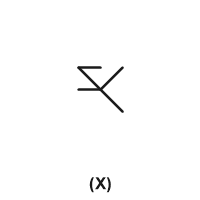
Figure (X)

Answer & explanation+

Correct answer: option 4

The correct answer is Option (4) → 
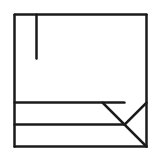
Option 4

Figure (X) is made of 4 straight lines. Look for the same shape, in the same size and the same way round, among the lines of each option. It can be traced in Option (4) (green lines below); the other options hold only a changed copy of it.
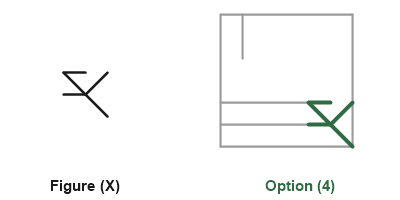
Figure for the solution

Option (1) — Incorrect. It contains (X) flipped top to bottom (its water image), not (X) as it is given.

Option (2) — Incorrect. It contains the mirror image of (X) (left and right swapped), not (X) as it is given.

Option (3) — Incorrect. It contains a shape like (X) with one of its lines missing, so (X) cannot be traced completely.

Advertisement

Practise more on Non-Verbal Reasoning

Chapter-wise mocks on the real NTA exam screen, with solutions and your rank. Your first mocks are free.

Start free mocks →

Advertisement

Next questions

  1. A village has a population of 2,000, of whom 800 are workers. What is its worker-population ratio?Economics · Indian Economic Development: Employment - Growth, Informalisation and Other Issues
  2. How many methods are used to calculate the operating profit in the cash flow statement?Accountancy Part B · Cash Flow Statement
  3. 'गिनती' शब्द में प्रयुक्त प्रत्यय है -Hindi · प्रत्यय
  4. Which of the following is an example of a major value cherished in Indian society?Business Studies · Business Environment
  5. Which of the following pairs is correctly matched?Psychology · Therapeutic Approaches
  6. Which of the following pairs is correctly matched?Economics · Indian Economic Development: Human Capital Formation in India
  7. Choose an example of wasting time based on the passage from the options given below:-English · Comprehension - (Narrative / Factual)
  8. Apart from being a military leader, what other aspects of Babur's interests were? A. potteryB. manuscriptsC. architectureD. gardeningE. bee…Fine Arts · The Mughal School of Miniature Painting
  9. Tokheho Sema, a young graduate from Nagaland read the article on bamboo cultivation and its potential industry. He met the Nodal officer of…Entrepreneurship · Entrepreneurial Opportunity
  10. When the market rate of interest falls, what happens to the demand for money?Economics · Macro Economics: Money and Banking