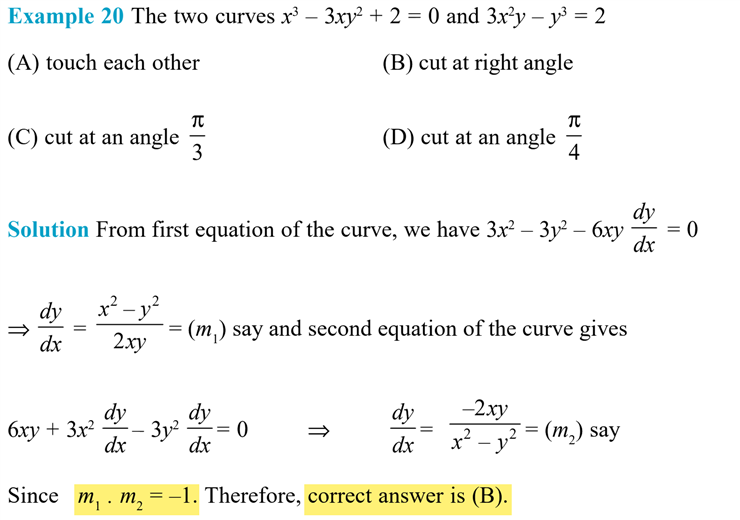
The two curves \(x^3-3xy^2+15=0\) and \(3x^2y-y^3+17=0\):
Answer & explanation
Correct answer: option 1
The correct answer is Option (1) → cut at right angles
The angle between the curves at a common point is the angle between their tangents there. The slopes come from implicit differentiation.
First curve, \(x^3-3xy^2+15=0\):
\( \displaystyle 3x^2 - 3y^2 - 6xy\frac{dy}{dx} = 0 \)
\( \displaystyle m_1 = \frac{x^2-y^2}{2xy} \)
Second curve, \(3x^2y-y^3+17=0\):
\( \displaystyle 6xy + 3x^2\frac{dy}{dx} - 3y^2\frac{dy}{dx} = 0 \)
\( \displaystyle m_2 = -\frac{2xy}{x^2-y^2} \)
At a common point x ≠ 0 (else the first equation gives 15 = 0), y ≠ 0 (else the second gives 17 = 0) and \(x^2 \ne y^2\) (putting y = x or y = −x into the two equations gives two different values of \(x^3\)). So both slopes are defined there, and
\( \displaystyle m_1 m_2 = \frac{x^2-y^2}{2xy}\times\left(-\frac{2xy}{x^2-y^2}\right) \)
\( = -1 \)
The product of the slopes is −1, so the tangents are perpendicular and the curves cut at right angles.
NCERT Exemplar:
Application of Derivatives