
Consider an economy with a fixed amount of resources and a given state of technology. It produces only two goods, Goods A and Goods B. The combinations showing the maximum output of the two goods that can be produced (when the given resources and technology are fully used) are plotted on a graph and joined to form the curve below. Two other points, E and F, are also marked on the graph.
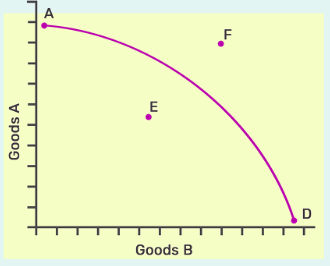
Based on the above graph, answer the following questions.
The economy is producing at a point on the curve. It now wants to produce more of Goods B without leaving any resource idle. What must happen?
Answer & explanation
Correct answer: option 1
The correct answer is Option (1) → It must produce less of Goods A.
On the curve, all resources are already in use. More Goods B needs resources taken out of Goods A, so the economy must produce less of Goods A. This is a movement along the curve.
Option (1) It must produce less of Goods A. — Correct. More of one good means less of the other when resources are fully used.
Option (2) It can also produce more of Goods A. — Incorrect. More of both would need more resources; nothing is idle to draw on.
Option (3) It must move to point F. — Incorrect. F is beyond the curve and cannot be produced with the present resources.
Option (4) It must move to point E. — Incorrect. E is below the curve, where some resources are idle. The economy wants to keep them all in use.
NCERT (2026-27): “Production Possibility Frontier If more of the scarce resources are used in the production of corn, less resources are available for the production of cotton and vice versa. Therefore, if we want to have more of one of the goods, we will have less of the other good. Thus, there is always a cost of having a little more of one good in terms of the amount of the other good that has to be forgone. …” |