CUETMOCK
  • Pricing
  • Mentors
Log inStart freeStart free mocks→

First test, then trust

Try a free CUET mock test.

Join 5,00,000+ students who rehearsed exam day on the exact NTA screen before sitting CUET. On the web and on Android.

Start free mocks →Get the Android app
CUETMOCK

India's #1 CUET Mock Test Platform. Original NCERT-based questions on the exact NTA exam screen — trusted by 5,00,000+ students since CUET 2022.

Get it onGoogle PlayScan to download the CUETMOCK app

Mock tests

  • CUET mock test series
  • Browse all papers
  • Commerce mocks
  • Humanities (Arts) mocks
  • Science mocks
  • Languages & GAT mocks
  • Free practice questions
  • Pricing

Resources

  • CUET exam guide
  • CUET syllabus
  • Universities accepting CUET
  • Expert blogs
  • News & notifications
  • Webinars & counselling
  • CUET score calculator
  • How we estimate your rank
  • FAQs

Company

  • About us
  • Our leadership & team
  • Our toppers
  • Mentors
  • For schools
  • Contact us
  • Terms
  • Privacy
  • Refund policy

Talk to us

+91 7696 6630 56info@cuetmock.comWhatsApp us

Our other platforms

  • JEE Mock — For IIT-JEE aspirants
  • NEET Mock — For NEET aspirants

Newsletter

Exam updates, study material and offers — no spam.

© 2026 NYC Ventures Pvt. Ltd.

701-702, Royal Business Park, Zirakpur, Punjab - 140603

  • Terms of use
  • Privacy policy
  • Refund policy
  • Contact us

iCUETMOCK is an independent preparation platform, not affiliated with the National Testing Agency (NTA). Always check exam details on the official NTA website.

  • Home
  • Mock tests
  • CUET guide
  • Pricing
  • Log in
Home/Practice questions/Psychology
PsychologySocial Influence and Group Processes

Which of the following is one way to counteract groupthink, the proce…

Which of the following is one way to counteract groupthink, the process described by Irving Janis?

Answer & explanation+

Correct answer: option 4

The correct answer is Option (4) → Inviting outside experts to evaluate decisions

OptionReason
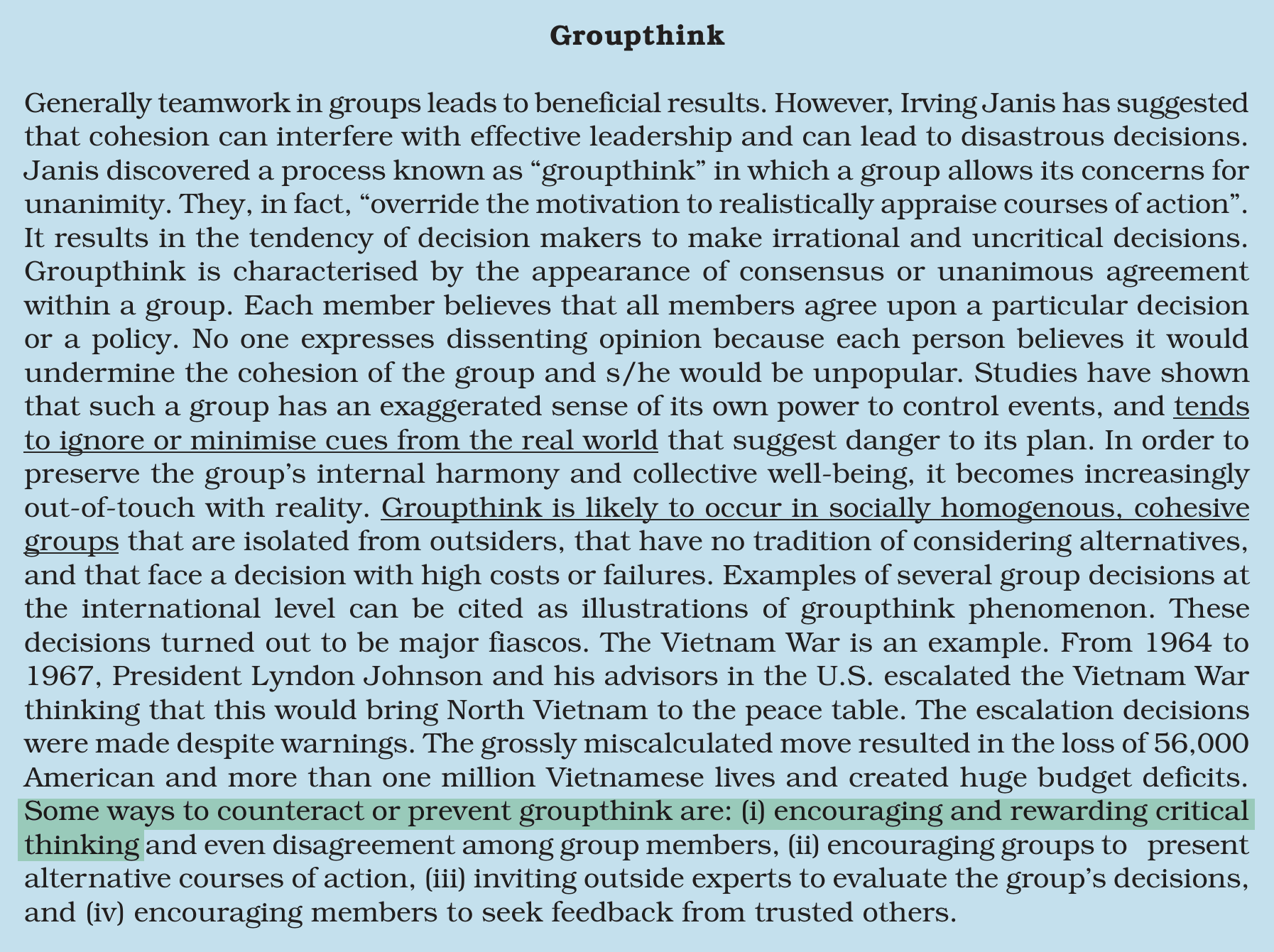
Option (1): Avoiding outside evaluation of decisions. Incorrect.Keeping decisions away from outside review leaves the group isolated from outsiders. Such isolation is one of the conditions under which the problem is likely to occur.
Option (2): Maintaining a socially homogenous group. Incorrect.A socially homogenous, cohesive group is a setting in which the problem is likely to occur. Members think alike, and no one voices a dissenting opinion for fear of being unpopular.
Option (3): Minimising cues from the real world. Incorrect.Ignoring or minimising cues from the real world that suggest danger is a sign of the problem itself. Such a group has an exaggerated sense of its own power to control events.
Option (4): Inviting outside experts to evaluate decisions. Correct.Inviting outside experts to evaluate the group's decisions brings in a view from beyond the group. It is one of the ways to counteract or prevent groupthink, along with rewarding critical thinking and presenting alternative courses of action.

NCERT (2026-27):

NCERT extract

Advertisement

Practise more on Social Influence and Group Processes

Chapter-wise mocks on the real NTA exam screen, with solutions and your rank. Your first mocks are free.

Start free mocks →

Advertisement

Next questions

  1. In a test, a student got 39% marks and passed by 12 marks. In the same test another student got 27% of the marks and got 25% less than the…General Aptitude Test · Numerical Ability
  2. Statement I: At independence, Indian agriculture was marked by low productivity and the intense poverty of a large section of the rural pop…Sociology · Social Change and Development in India: Change and Development in Rural Society
  3. Raymond Cattell used factor analysis to identify which of the following traits?Psychology · Self and Personality
  4. Find the minor of element 6 in the determinant Δ = […] .Maths. Section B1 · Determinants
  5. What artistic style did Jamini Roy adopt after rejecting academic training?Fine Arts · The Bengal School and Cultural Nationalism
  6. Which biographer of Gandhiji described non-cooperation as negative enough to be peaceful but positive enough to be effective?History · Modern India: Mahatma Gandhi and the Nationalist movement
  7. The Persian Translation and illustrated version of the Hindu epic Mahabharata is known as _____.Fine Arts · The Mughal School of Miniature Painting
  8. What fundamental right did the Supreme Court interpret as including the right to shelter in the Olga Tellis case?Political Science · Citizenship
  9. Select the most appropriate meaning of the given idiom. To get into hot waterEnglish · Grammar: Idioms
  10. Statement I: The ionisation enthalpy of Mn+ is higher than that of Cr+.Statement II: The third ionisation enthalpy of iron is lower than th…Chemistry · Inorganic: D and F Block Elements