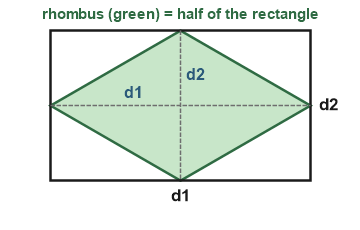
If the diagonals of a rhombus are equal to the sides of a rectangle, then area of the rectangle is:
Answer & explanation
Correct answer: option 1
The correct answer is Option (1) → twice the area of the rhombus
The area of a rhombus is half the product of its diagonals, because the diagonals cut it into four right triangles. A rectangle whose sides are the two diagonals has the full product as its area.
Area of the rhombus \(\displaystyle =\frac{1}{2}d_1d_2\)
Area of the rectangle with sides \(d_1\) and \(d_2\) \(=d_1d_2\)
Area of the rectangle \(\displaystyle =2\times\frac{1}{2}d_1d_2\), twice the area of the rhombus
In the picture the rhombus sits inside the rectangle with its corners at the mid-points of the sides; each of the four white corner triangles matches one green triangle, so the rhombus fills half the rectangle.