CUETMOCK
  • Pricing
  • Mentors
Log inStart freeStart free mocks→

First test, then trust

Try a free CUET mock test.

Join 5,00,000+ students who rehearsed exam day on the exact NTA screen before sitting CUET. On the web and on Android.

Start free mocks →Get the Android app
CUETMOCK

India's #1 CUET Mock Test Platform. Original NCERT-based questions on the exact NTA exam screen — trusted by 5,00,000+ students since CUET 2022.

Get it onGoogle PlayScan to download the CUETMOCK app

Mock tests

  • CUET mock test series
  • Browse all papers
  • Commerce mocks
  • Humanities (Arts) mocks
  • Science mocks
  • Languages & GAT mocks
  • Free practice questions
  • Pricing

Resources

  • CUET exam guide
  • CUET syllabus
  • Universities accepting CUET
  • Expert blogs
  • News & notifications
  • Webinars & counselling
  • CUET score calculator
  • How we estimate your rank
  • FAQs

Company

  • About us
  • Our leadership & team
  • Our toppers
  • Mentors
  • For schools
  • Contact us
  • Terms
  • Privacy
  • Refund policy

Talk to us

+91 7696 6630 56info@cuetmock.comWhatsApp us

Our other platforms

  • JEE Mock — For IIT-JEE aspirants
  • NEET Mock — For NEET aspirants

Newsletter

Exam updates, study material and offers — no spam.

© 2026 NYC Ventures Pvt. Ltd.

701-702, Royal Business Park, Zirakpur, Punjab - 140603

  • Terms of use
  • Privacy policy
  • Refund policy
  • Contact us

iCUETMOCK is an independent preparation platform, not affiliated with the National Testing Agency (NTA). Always check exam details on the official NTA website.

  • Home
  • Mock tests
  • CUET guide
  • Pricing
  • Log in
Home/Practice questions/Political Science
Political ScienceContemporary World Politics: International Organisations

The non-permanent member of the Security Council is elected by:

The non-permanent member of the Security Council is elected by:

Answer & explanation+

Correct answer: option 3

The correct answer is Option (3) → General Assembly

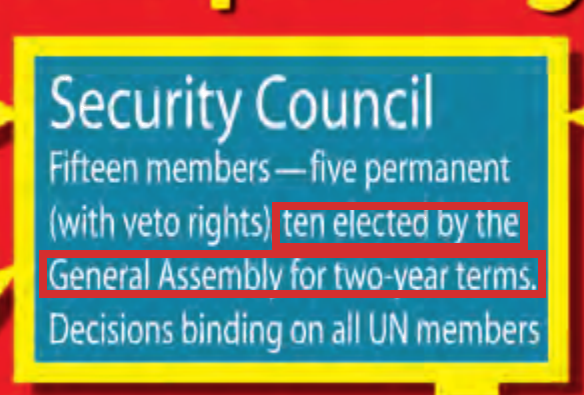
The Security Council has fifteen members: five permanent members with veto rights and ten members elected by the General Assembly for two-year terms. These non-permanent members serve for only two years at a time, cannot be re-elected immediately after a term, are elected so that they represent all continents of the world, and do not have the veto power.


NCERT (2026-27): “Reform of Structures and Processes … In the Security Council, there are five permanent members and ten non-permanent members. The Charter gave the permanent members a privileged position to bring about stability in the world after the Second World War. The main privileges of the five permanent members are permanency and the veto power. The non-permanent members serve for only two years at a time and give way after that period to newly elected members. A country cannot be re-elected immediately after completing a term of two years. The nonpermanent members are elected in a manner so that they represent all continents of the world. Most importantly, the nonpermanent members do not have the veto power.…”

NCERT extract

Chart ‘The United Nations System’, chapter ‘International Organisations’ (2026-27): Security Council – fifteen members, five permanent (with veto rights), ten elected by the General Assembly for two-year terms (boxed in red)

Advertisement

Practise more on Contemporary World Politics: International Organisations

Chapter-wise mocks on the real NTA exam screen, with solutions and your rank. Your first mocks are free.

Start free mocks →

Advertisement

Next questions

  1. What is the remainder when 2 ^ 20 is divided by 7?Maths. Section B1 · Other - Maths Section B1
  2. If the diagonals of a rhombus are equal to the sides of a rectangle, then area of the rectangle is:General Aptitude Test · Quantitative Reasoning
  3. निम्नलिखित में से किस वाक्य में भविष्य काल नहीं है?Hindi · व्याकरण - सकाल
  4. Which of the following are not macroeconomic variables:A. Aggregate outputB. General price levelC. Employment of workers in a leather facto…Economics · Macro Economics: Introduction
  5. If y=e^-x(A cos x+B sin x), then y satisfiesMaths. Section A · Differential Equations
  6. Karachi Congress Resolution, 1931 spelt out the vision of :Sociology · Social Change and Development in India: The Constitution and Social Change
  7. Britain attacked Egypt in 1956 on which of the following issue?Political Science · Politics in India Since Independence: India's External Relations
  8. Madhu's work can be understood as which type of work?Sociology · Social Change and Development in India: Change and Development in industrial Society
  9. In code language,if ‘fast and furious' is written as 'co mojo’, 'do it fast' is written as ‘cha mo ga’, and 'she did it' is written as 'ga…General Aptitude Test · Verbal Reasoning
  10. A long solenoid is formed by winding insulated copper wire at the rate of 20 turns per cm. The current that is necessary to produce a magne…Physics · Moving Charges and Magnetism