
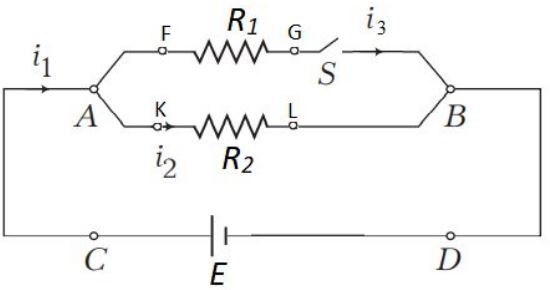
In the circuit diagram shown in the figure, the resistance \( R_1 = 10\,\Omega \), \( R_2 = 15\,\Omega \) and \( E = 20\,\mathrm{V} \). When the switch S is closed, the ratio of \( i_1 \) to \( i_3 \) will be
Answer & explanation
Correct answer: option 4
The correct answer is Option (4) → 5 : 3
With S closed, \( R_1 \) and \( R_2 \) are in parallel between A and B, and this pair is connected directly across the cell (ideal, no internal resistance given). So the full 20 V acts across each branch. \( i_3 \) flows through \( R_1 \), \( i_2 \) through \( R_2 \), and \( i_1 \) is the main-line current.
\( \displaystyle i_3 = \frac{E}{R_1} = \frac{20\,\mathrm{V}}{10\,\Omega} = 2\,\mathrm{A} \)
\( \displaystyle i_2 = \frac{E}{R_2} = \frac{20\,\mathrm{V}}{15\,\Omega} = \frac{4}{3}\,\mathrm{A} \)
By Kirchhoff's junction rule at A:
\( \displaystyle i_1 = i_2 + i_3 = \frac{4}{3} + 2 = \frac{10}{3}\,\mathrm{A} \)
\( \displaystyle \frac{i_1}{i_3} = \frac{10/3}{2} = \frac{5}{3} \)
So \( i_1 : i_3 = 5 : 3 \).