CUETMOCK
  • Pricing
  • Mentors
Log inStart freeStart free mocks→

First test, then trust

Try a free CUET mock test.

Join 5,00,000+ students who rehearsed exam day on the exact NTA screen before sitting CUET. On the web and on Android.

Start free mocks →Get the Android app
CUETMOCK

India's #1 CUET Mock Test Platform. Original NCERT-based questions on the exact NTA exam screen — trusted by 5,00,000+ students since CUET 2022.

Get it onGoogle PlayScan to download the CUETMOCK app

Mock tests

  • CUET mock test series
  • Browse all papers
  • Commerce mocks
  • Humanities (Arts) mocks
  • Science mocks
  • Languages & GAT mocks
  • Free practice questions
  • Pricing

Resources

  • CUET exam guide
  • CUET syllabus
  • Universities accepting CUET
  • Expert blogs
  • News & notifications
  • Webinars & counselling
  • CUET score calculator
  • How we estimate your rank
  • FAQs

Company

  • About us
  • Our leadership & team
  • Our toppers
  • Mentors
  • For schools
  • Contact us
  • Terms
  • Privacy
  • Refund policy

Talk to us

+91 7696 6630 56info@cuetmock.comWhatsApp us

Our other platforms

  • JEE Mock — For IIT-JEE aspirants
  • NEET Mock — For NEET aspirants

Newsletter

Exam updates, study material and offers — no spam.

© 2026 NYC Ventures Pvt. Ltd.

701-702, Royal Business Park, Zirakpur, Punjab - 140603

  • Terms of use
  • Privacy policy
  • Refund policy
  • Contact us

iCUETMOCK is an independent preparation platform, not affiliated with the National Testing Agency (NTA). Always check exam details on the official NTA website.

  • Home
  • Mock tests
  • CUET guide
  • Pricing
  • Log in
Home/Practice questions/General Aptitude Test
General Aptitude TestVerbal ReasoningSyllogism

In the question two statements are given, followed by two conclusions…

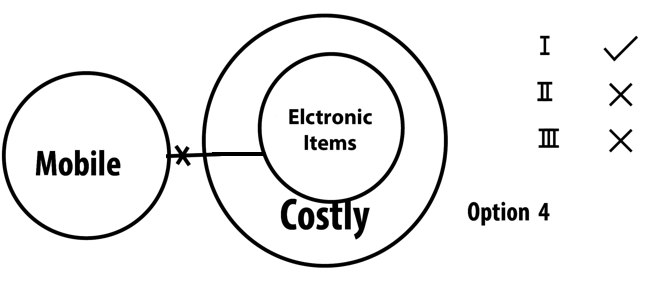
In the question two statements are given, followed by two conclusions, I and II. You have to consider the statements to be true even if they seem to be at variance from commonly known facts. You have to decide which of the given conclusions, if any, follows from the given statements.

Statements:

l.No mobile is an electronic item.

ll.All electronic items are costly.

Conclusions:

I. No costly is a mobile.

II. Some costly are mobile.

Answer & explanation+

Correct answer: option 4

Advertisement

Practise more on Verbal Reasoning

Chapter-wise mocks on the real NTA exam screen, with solutions and your rank. Your first mocks are free.

Start free mocks →

Advertisement

Next questions

  1. Statement I: The inner orbital complex [Mn(CN)6]3− is diamagnetic.Statement II: An inner orbital complex may contain unpaired electrons.Chemistry · Inorganic: Coordination Compounds
  2. According to the writer, why is there only one Thomas A. Edison? Because __________.English · Comprehension - (Narrative / Factual)
  3. 'The degree of concentration of authority (centralisation) or its dispersal (decentralisation) will depend upon the situations and circumst…Business Studies · Principles of Management
  4. A man can row at 7 km/h in still water. When the stream is flowing at 5 km/h, he takes 7 hours to row to a place and come back. How far is…Applied Maths. Section B2 · Numbers, Quantification and Numerical Applications
  5. Choose the most appropriate adjective. Those are probably the ___________ chairs in the store.English · Grammar: Adjective
  6. What is the electric potential from 3 nC of charge at a distance of 9 cm?Physics · Electrostatic Potential and Capacitance
  7. Which of the following courts does not have power to punish for contempt of court?Legal Studies · Judiciary
  8. The documentary evidence in support of a transaction is known as...........Accountancy · Introduction to Accounting
  9. The rate of doing work is called:General Aptitude Test · General Knowledge
  10. The α -amino acid which contains an aromatic side chain isChemistry · Organic: Biomolecules