The presence of \(SO_2\) is not detected by
Answer & explanation
Correct answer: option 2
The correct answer is Option (2) → Turning of red litmus blue
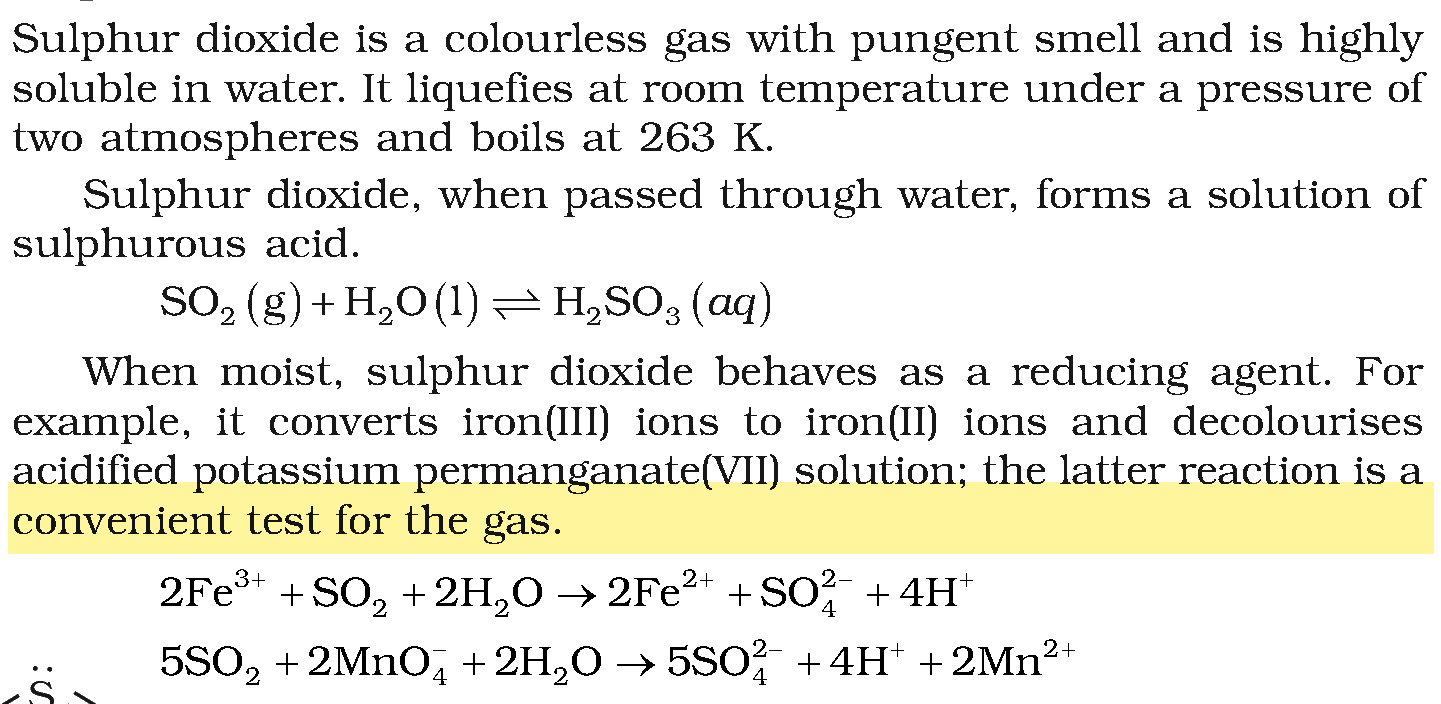
Sulphur dioxide is an acidic oxide: in water it forms sulphurous acid, so it turns blue litmus red. It can never turn red litmus blue, which is the behaviour of a base. So \( \ce{SO2} \) is not detected by turning red litmus blue.
\( \displaystyle \ce{SO2 + H2O <=> H2SO3} \)
Option (1) Its characteristic pungent smell — Detects SO2. \( \ce{SO2} \) is a colourless gas with a pungent smell.
Option (2) Turning of red litmus blue — Does not detect SO2. \( \ce{SO2} \) is acidic; it turns blue litmus red, never red litmus blue.
Option (3) Turning of acidified potassium dichromate solution green — Detects SO2. \( \ce{SO2} \) reduces orange \( \ce{Cr2O7^2-} \) to green \( \ce{Cr^3+} \):
\( \ce{Cr2O7^2- + 3SO2 + 2H+ -> 2Cr^3+ + 3SO4^2- + H2O} \)
Option (4) Decolorisation of acidified potassium permanganate solution — Detects SO2. \( \ce{SO2} \) reduces purple \( \ce{MnO4^-} \) to nearly colourless \( \ce{Mn^2+} \):
\( \ce{5SO2 + 2MnO4- + 2H2O -> 5SO4^2- + 4H+ + 2Mn^2+} \)
Note: This question is from the pre-rationalised NCERT book (2022-23). The topic is not there in the latest NCERT book (2026-27), and it is also out of the CUET 2026 syllabus.
NCERT (Pre-rationalised edition, 2022-23):
Sulphur Dioxide – …