
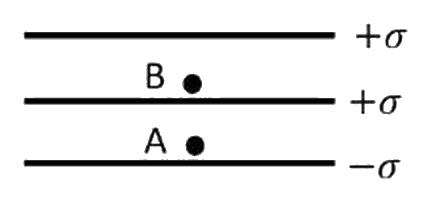
In this diagram, three infinite plane sheets of charges are shown with surface charge densities \( +\sigma \), \( +\sigma \), \( -\sigma \). The value of electric field at points A and B are
Answer & explanation
Correct answer: option 3
The correct answer is Option (3) → \( \displaystyle\frac{3\sigma}{2\varepsilon_0} \) at A and \( \displaystyle\frac{\sigma}{2\varepsilon_0} \) at B
An infinite plane sheet of charge produces a uniform field of magnitude \( \sigma/2\varepsilon_0 \) on either side, away from a positive sheet and towards a negative sheet. By the superposition principle the fields of the three sheets add as vectors. Take the downward direction as positive, in units of \( \sigma/2\varepsilon_0 \).
Point B (between the top and the middle sheets):
Top sheet \( (+\sigma) \): B is below it, so the field points down, \( +1 \).
Middle sheet \( (+\sigma) \): B is above it, so the field points up, \( -1 \).
Bottom sheet \( (-\sigma) \): the field points towards it, down, \( +1 \).
\( \displaystyle E_B = (1 - 1 + 1)\,\frac{\sigma}{2\varepsilon_0} = \frac{\sigma}{2\varepsilon_0} \)
Point A (between the middle and the bottom sheets):
Top sheet \( (+\sigma) \): A is below it, so the field points down, \( +1 \).
Middle sheet \( (+\sigma) \): A is below it, so the field points down, \( +1 \).
Bottom sheet \( (-\sigma) \): the field points towards it, down, \( +1 \).
\( \displaystyle E_A = (1 + 1 + 1)\,\frac{\sigma}{2\varepsilon_0} = \frac{3\sigma}{2\varepsilon_0} \)