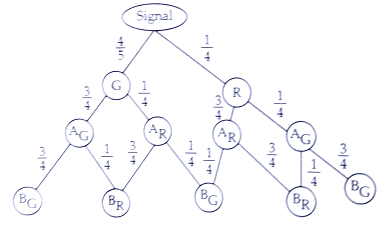
A signal which can be green or red with probability $\frac{4}{5}$ and $\frac{1}{5}$ respectively, is received by station A and then transmitted to station B. The probability of each station receiving the signal correctly is $\frac{3}{4}$. IF the signal received at station B is green, then the probability that the original signal was green is
Answer & explanation
Correct answer: option 3
It is evident from the tree diagram that
$P(B_G)=\frac{4}{5}×\frac{3}{4}×\frac{3}{4}+\frac{4}{5}×\frac{1}{4}×\frac{1}{4}+\frac{1}{5}×\frac{3}{4}×\frac{1}{4}+\frac{1}{5}×\frac{1}{4}×\frac{3}{4}=\frac{23}{40}$
$P(\frac{B_G}{G})=\frac{3}{4}×\frac{3}{4}+\frac{1}{4}×\frac{1}{4}=\frac{5}{8}$
$∴ P(B_G ∩ G) = P(G) P(\frac{B_G}{G})$
$⇒ P(B_G ∩ G) =\frac{4}{5}×\frac{5}{8}=\frac{1}{2}$
∴ Required Probability $=P(\frac{B_G}{G})=\frac{P(B_G ∩ G)}{P(B_G)}$
$=\frac{\frac{1}{2}}{\frac{23}{40}}=\frac{20}{23}$