
CUETMOCK
  • Pricing
  • Mentors
Log inStart freeStart free mocks→

First test, then trust

Try a free CUET mock test.

Join 5,00,000+ students who rehearsed exam day on the exact NTA screen before sitting CUET. On the web and on Android.

Start free mocks →Get the Android app
CUETMOCK

India's #1 CUET Mock Test Platform. Original NCERT-based questions on the exact NTA exam screen — trusted by 5,00,000+ students since CUET 2022.

Get it onGoogle PlayScan to download the CUETMOCK app

Mock tests

  • CUET mock test series
  • Browse all papers
  • Commerce mocks
  • Humanities (Arts) mocks
  • Science mocks
  • Languages & GAT mocks
  • Free practice questions
  • Pricing

Resources

  • CUET exam guide
  • CUET syllabus
  • Universities accepting CUET
  • Expert blogs
  • News & notifications
  • Webinars & counselling
  • CUET score calculator
  • How we estimate your rank
  • FAQs

Company

  • About us
  • Our leadership & team
  • Our toppers
  • Mentors
  • For schools
  • Contact us
  • Terms
  • Privacy
  • Refund policy

Talk to us

+91 7696 6630 56info@cuetmock.comWhatsApp us

Our other platforms

  • JEE Mock — For IIT-JEE aspirants
  • NEET Mock — For NEET aspirants

Newsletter

Exam updates, study material and offers — no spam.

© 2026 NYC Ventures Pvt. Ltd.

701-702, Royal Business Park, Zirakpur, Punjab - 140603

  • Terms of use
  • Privacy policy
  • Refund policy
  • Contact us

iCUETMOCK is an independent preparation platform, not affiliated with the National Testing Agency (NTA). Always check exam details on the official NTA website.

  • Home
  • Mock tests
  • CUET guide
  • Pricing
  • Log in
Home/Practice questions/Chemistry
ChemistryOrganic: Aldehydes, Ketones and Carboxylic Acids

Carboxylic acids do not give the characteristic reaction of carbonyl…

Answer the question on the basis of passage given below:

Aldehydes and ketones are two important classes of organic compounds which are widely used in the synthesis of a variety of other organic compounds. Due to the polarity of the carbonyl group, they undergo nucleophilic addition reactions. Broadly speaking, these addition reactions are of two types- one in which simply the addition of the nucleophilic reagent occurs across \(>C=O\) bond and the other in which addition is followed by the elimination of a molecule of water. A number of ammonia derivatives such as hydroxylamine, hydrazine, phenylhydrazine, 2,4-dinitrophenylhydrazine and semicarbazide belong to the second category of reactions. These derivatives are used for the identification and characterization of aldehydes/ketones. Both types of nucleophilic addition reactions are influenced by steric and electronic factors. In general, aliphatic aldehydes are more reactive than aromatic aldehydes. The aliphatic aldehydes reduce both Fehling's solution and Tollen's reagent but aromatic aldehydes reduce only Tollen's reagent. Like aldehydes, aromatic ketones are less reactive than aliphatic ketones towards nucleophilic addition reactions.

Phenols and carboxylic acids are acidic in nature. Both dissolve in \(NaOH\) solution and turn blue litmus red. However carboxylic acids are much stronger acids than phenols and decompose \(NaHCO_3\) with the evolution of \(CO_2\) but phenols do not. Both electron-donating and electron-withdrawing substituents influence the acid strength of aliphatic as well as aromatic acids. Unlike all other aliphatic acids, formic acid has reducing properties and also does not show reactions of the alkyl group.

Carboxylic acids do not give the characteristic reaction of carbonyl group because:

Answer & explanation+

Correct answer: option 4

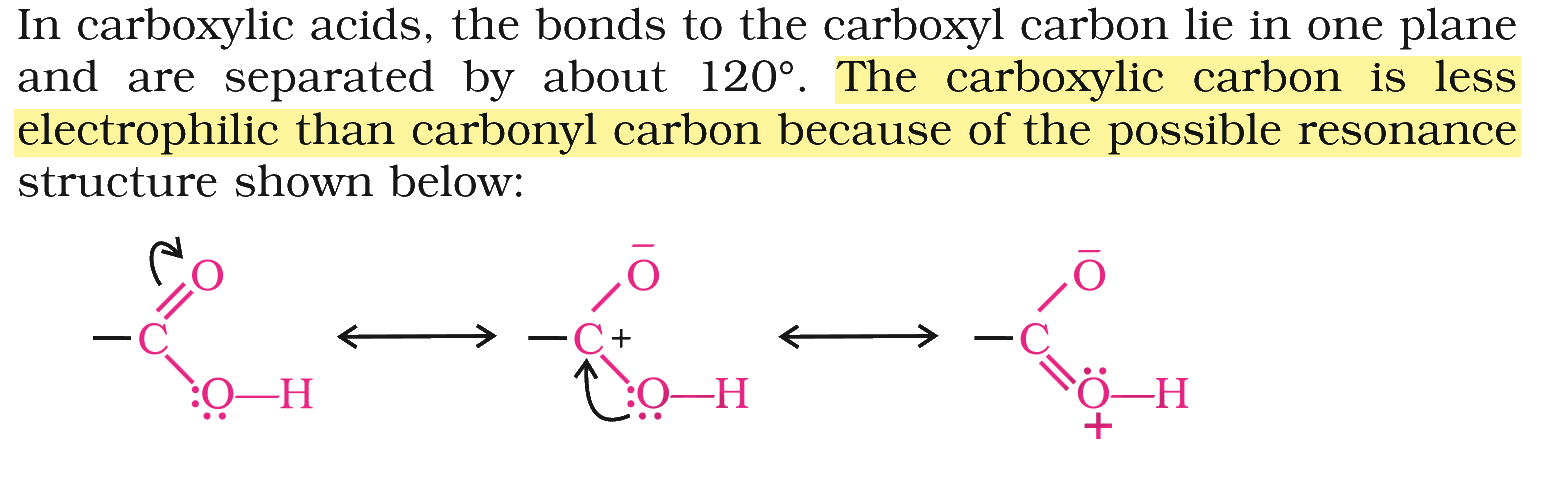
The correct answer is Option (4) → carbonyl carbon of carboxyl group is less electrophilic

The characteristic reactions of the carbonyl group begin with a nucleophile attacking the electrophilic carbonyl carbon. In a carboxyl group a lone pair on the –OH oxygen is delocalised into the C=O group by resonance (structures below), which partly cancels the positive charge on the carbon. So the carboxyl carbon is less electrophilic than the carbonyl carbon of an aldehyde or ketone, and nucleophiles do not add to it in the usual way.

Why the other options are incorrect

  • Option (1) the oxygen atom of the OH group does not contain lone pair of electrons — Incorrect. The –OH oxygen has two lone pairs; it is one of them that is delocalised into the C=O group and causes the effect.

  • Option (2) carbonyl carbon of carboxyl group is more electrophilic — Incorrect. A more electrophilic carbon would make nucleophilic addition easier, not prevent it.

  • Option (3) carbonyl carbon of carboxyl group is more nucleophilic — Incorrect. The carbonyl carbon is an electron-poor centre in every carbonyl compound; resonance only makes it less positive, it does not turn it into a nucleophile.

NCERT (2026-27 edition):
Structure of Carboxyl Group
Textbook extract

Advertisement

Practise more on Organic: Aldehydes, Ketones and Carboxylic Acids

Chapter-wise mocks on the real NTA exam screen, with solutions and your rank. Your first mocks are free.

Start free mocks →

Advertisement

Next questions

  1. Read the following statements about biotechnology and its applications:A. Biotechnology essentially deals with industrial scale production…Biology · Biotechnology and its Applications
  2. Arrange the following in ascending order: (A) Aravidu dynasty(B) Saluva dynasty(C) Tuluva dynasty(D) Sangama dynasty Choose the correct ans…History · Medieval India: An Imperial Capital: Vijayanagara
  3. In a region, steady and uniform electric and magnetic fields are present. These two fields are parallel to each other. A charged particle i…Physics · Moving Charges and Magnetism
  4. The diagonal of a square is 4√2 cm. The diagonal of another square whose area is double that of the first square, is:General Aptitude Test · Quantitative Reasoning
  5. Select the most appropriate ANTONYM of the given word. VigilantEnglish · Antonyms
  6. Select the letter cluster that will replace the question mark (?) in the following series. TYA, AFH, HMO, OTV, ?General Aptitude Test · Verbal Reasoning
  7. Select the letter-cluster from among the given options that can replace the question mark (?) in the following series. AY, BX, ?, DV, EU, FTGeneral Aptitude Test · General Ability
  8. Which artist painted the Bhagvata Purana in Mewar during the reign of Jagat Singh I?Fine Arts · The Rajasthani Schools of Painting
  9. Why did the Green Revolution disrupt the relationship between tenants and landowners?Sociology · Social Change and Development in India: Change and Development in Rural Society
  10. What is the value of 100 divided by 0?General Aptitude Test · Quantitative Reasoning