
Read the following statements about the polymerase chain reaction (PCR):
A. Multiple copies of the gene of interest are synthesised in vitro using two sets of primers and the enzyme DNA polymerase.
B. The replication of the DNA segment is repeated many times, so that the segment is amplified.
C. The amplified DNA fragment can be ligated with a vector for further cloning.
D. The primers used in PCR are small, naturally occurring oligonucleotides that are complementary to the regions of DNA.
Choose the correct answer from the options given below:
Answer & explanation
Correct answer: option 1
The correct answer is Option (1) → A, B and C only
The polymerase chain reaction (PCR) makes many copies of a chosen piece of DNA outside the cell (in vitro). Each cycle has three steps: denaturation of the double-stranded DNA by heat, annealing of primers, and extension of the primers by DNA polymerase.
Statement A: Multiple copies of the gene of interest are synthesised in vitro using two sets of primers and the enzyme DNA polymerase. — True. PCR copies the gene of interest in a tube, using two sets of primers that mark the two ends of the region, and DNA polymerase that extends them.
Statement B: The replication of the DNA segment is repeated many times, so that the segment is amplified. — True. Each cycle doubles the number of copies. Repeating the cycle many times amplifies the segment to about a billion copies.
Statement C: The amplified DNA fragment can be ligated with a vector for further cloning. — True. Once enough copies are made, the fragment can be joined (ligated) to a vector and cloned further.
Statement D: The primers used in PCR are small, naturally occurring oligonucleotides that are complementary to the regions of DNA. — False. Primers are small oligonucleotides complementary to the ends of the region to be copied, but they are chemically synthesised in the laboratory, not naturally occurring.
NCERT Extract:
Amplification of Gene of Interest Using PCR – “PCR stands for Polymerase Chain Reaction. In this reaction, multiple copies of the gene (or DNA) of interest is synthesised in vitro using two sets of primers (small chemically synthesised oligonucleotides that are complementary to the regions of DNA) and the enzyme DNA polymerase. The enzyme extends the primers using the nucleotides provided in the reaction and the genomic DNA as template. If the process of replication of DNA is repeated many times, the segment of DNA can be amplified to approximately billion times, i.e., 1 billion copies are made. Such repeated amplification is achieved by the use of a thermostable DNA polymerase (isolated from a bacterium, Thermus aquaticus), which remain active during the high temperature induced denaturation of double stranded DNA. The amplified fragment if desired can now be used to ligate with a vector for further cloning (Figure 9.6).”
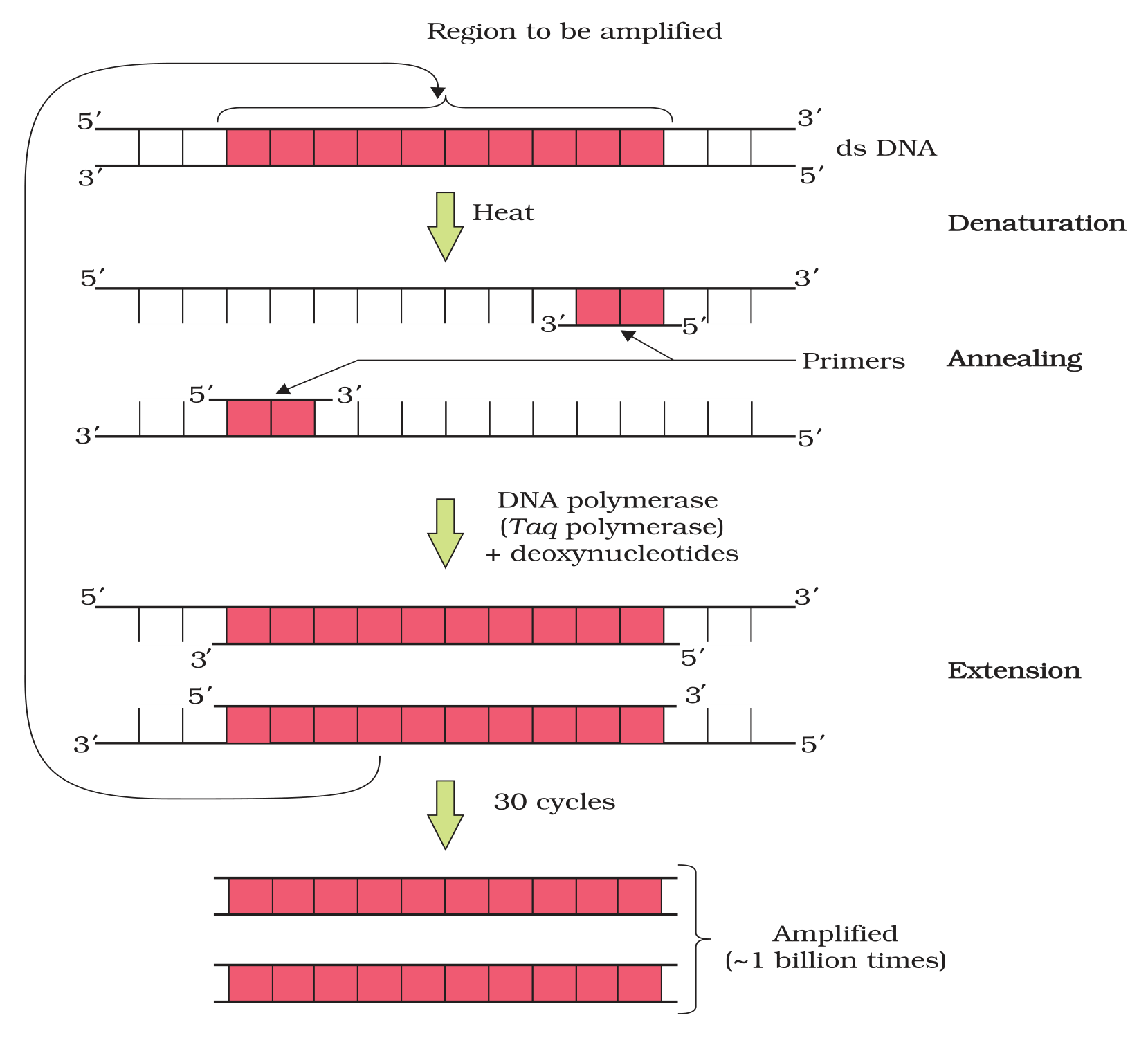
Figure 9.6 Polymerase chain reaction (PCR) : Each cycle has three steps: (i) Denaturation; (ii) Primer annealing; and (iii) Extension of primers