
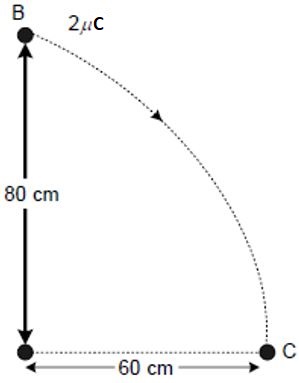
A point charge of 10 μC is placed at the origin. A charge of 2 µC is brought from B to C along the path as shown by arrow in the figure. The work done is
Answer & explanation
Correct answer: option 4
The correct answer is Option 4: 0.075 J
Given:
- Charge at origin: $Q = 10\,\mu C$
- Charge moved: $q = 2\,\mu C$
- Point $B = (0, 80\,\text{cm}) \Rightarrow r_B = 0.8\,\text{m}$
- Point $C = (60\,\text{cm}, 0) \Rightarrow r_C = 0.6\,\text{m}$
Formula:
Work done in moving a charge in an electric field:
$W = q (V_C - V_B)$
Where potential due to a point charge:
$V = \frac{kQ}{r}$
Step 1: Calculate potentials
$V_C = \frac{9 \times 10^9 \times 10 \times 10^{-6}}{0.6} = \frac{9 \times 10^4}{0.6} = 1.5 \times 10^5 \, \text{V}$
$V_B = \frac{9 \times 10^9 \times 10 \times 10^{-6}}{0.8} = \frac{9 \times 10^4}{0.8} = 1.125 \times 10^5 \, \text{V}$
Step 2: Work done
$W = 2 \times 10^{-6} \times (1.5 \times 10^5 - 1.125 \times 10^5)$
$W = 2 \times 10^{-6} \times 3.75 \times 10^4$
$W = 0.075 \, \text{J}$