
The figure shows the Haworth structures of the two anomers of D-(−)-fructose.
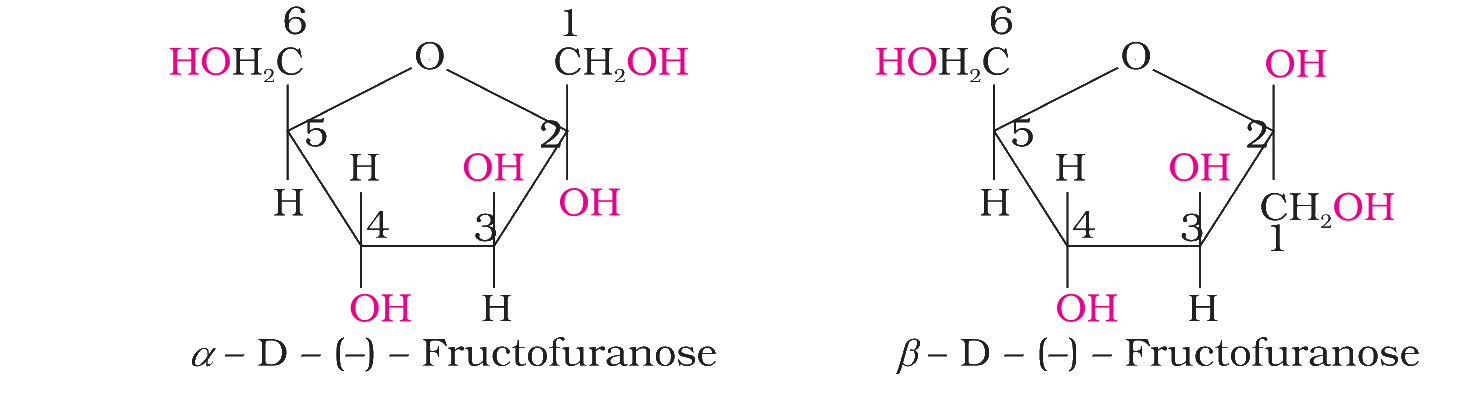
The two anomers differ in configuration at only one carbon atom. Which carbon atom is it?
Answer & explanation
Correct answer: option 1
The correct answer is Option (1) → C-2
Anomers differ only in the configuration at the anomeric carbon, the carbonyl carbon before the ring closes. Fructose has its keto group at C-2, and the ring forms when the –OH at C-5 adds to this group.
Comparing the two structures — only C-2 differs. In the α-form, C-2 has CH2OH above the ring and –OH below it; in the β-form, C-2 has –OH above the ring and CH2OH below it. C-3, C-4 and C-5 carry the same groups on the same sides in both forms.
Why the other options are incorrect
Option (2) C-1 — Incorrect. C-1 is the CH2OH group outside the ring. It changes position only because the groups on C-2 change; it carries two H atoms and is not asymmetric.
Option (3) C-5 — Incorrect. C-5 is the carbon whose –OH closes the ring. It has CH2OH above and H below the ring in both forms.
Option (4) C-3 — Incorrect. C-3 has –OH above and H below the ring in both forms.
NCERT (2026-27 edition):
10.1.2.2 Fructose – “Fructose also has the molecular formula C6H12O6 and on the basis of its reactions it was found to contain a ketonic functional group at carbon number 2 …”
“It also exists in two cyclic forms which are obtained by the addition of —OH at C5 to the (>C=O) group. The ring, thus formed is a five membered ring and is named as furanose with analogy to the compound furan. … The cyclic structures of two anomers of fructose are represented by Haworth structures as given.”
10.1.2.1 Glucose – “The two cyclic hemiacetal forms of glucose differ only in the configuration of the hydroxyl group at C1, called anomeric carbon (the aldehyde carbon before cyclisation). Such isomers, i.e., α-form and β-form, are called anomers.”
α-D-(−)-Fructofuranose and β-D-(−)-Fructofuranose