Read the passage carefully and answer the questions:
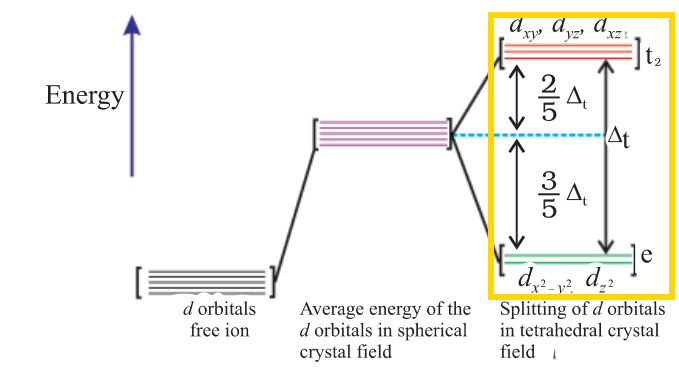
The degeneracy of the d orbitals has been removed due to ligand electron-metal electron repulsions in the octahedral complex to yield three orbitals of lower energy, \( t_{2g} \) set and two orbitals of higher energy, \( e_g \) set. This splitting of the degenerate levels due to the presence of ligands in a definite geometry is termed as crystal field splitting and the energy separation is denoted by Δo. Thus energy of the two \( e_g \) orbitals will increase by (3/5) Δo and that of three \( t_{2g} \) will decrease by (2/5) Δo. The crystal field splitting Δo depends upon the field produced by the ligand and charge on the metal ion. Some ligands are able to produce strong fields, in which case the splitting will be large, whereas others produce weak fields and consequently result in small splitting of d orbitals. Relative magnitude of crystal field splitting energy Δo and pairing energy, P (energy required for electron pairing in a single orbital) determine the formation of low spin (Δo > P) or high spin (Δo < P) complex. In tetrahedral coordination entity formation, the d-orbital splitting is inverted and is smaller as compared to the octahedral field splitting. The crystal field theory attributes the colour of the complex to d-d transition of the electron. The colour of the coordination compounds depends on the crystal field splitting. In the absence of ligand, crystal field splitting does not occur and hence the substance is colourless.
Which of the following relations is correct for the splitting of d orbitals in octahedral and tetrahedral crystal fields, considering same metal, the same ligands and metal-ligand distances?
Answer & explanation
Correct answer: option 1
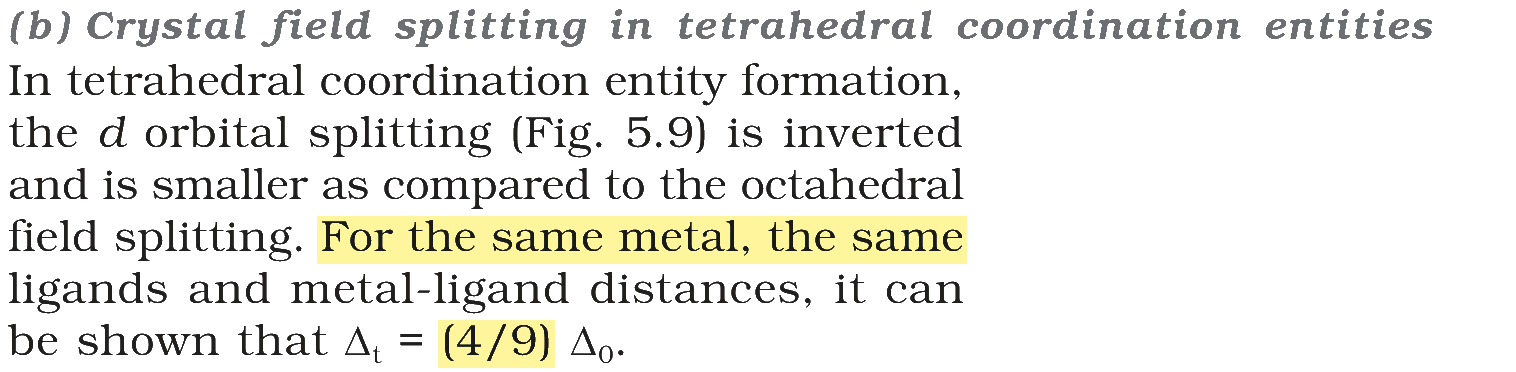
The correct answer is Option (1) → \(\Delta_t=\frac{4}{9}\Delta_o\)
In an octahedral field the six ligands approach along the axes and point straight at the \( e_g \) orbitals, which are raised in energy. In a tetrahedral field the splitting is inverted (\( e \) below, \( t_2 \) above) and much smaller, for two reasons:
There are only four ligands instead of six, which by itself gives about \( \frac{4}{6} = \frac{2}{3} \) of the splitting.
The ligands lie between the axes, so no ligand points directly at any d orbital, which reduces the splitting by a further factor of about \( \frac{2}{3} \).
\( \displaystyle \Delta_t = \frac{2}{3} \times \frac{2}{3}\,\Delta_o = \frac{4}{9}\,\Delta_o \)
So, for the same metal, ligands and metal–ligand distance, \( \Delta_t = \frac{4}{9}\Delta_o \). Because \( \Delta_t \) is so small, it rarely exceeds the pairing energy, and low spin tetrahedral complexes are rarely seen.
Why the other options are incorrect
Option (2) \(\Delta_t=\frac{9}{4}\Delta_o\) — Incorrect. This is the inverse ratio; it would make the tetrahedral splitting more than twice the octahedral one.
Option (3) \(\Delta_t=\frac{2}{5}\Delta_o\) — Incorrect. \( \frac{2}{5}\Delta_o \) is how far the \( t_{2g} \) orbitals are lowered in the octahedral field, not a ratio of two splittings.
Option (4) \(\Delta_t=\frac{3}{5}\Delta_o\) — Incorrect. \( \frac{3}{5}\Delta_o \) is how far the \( e_g \) orbitals are raised in the octahedral field, as the passage states.
NCERT (2026-27 edition):
Crystal Field Splitting in Tetrahedral Coordination Entities