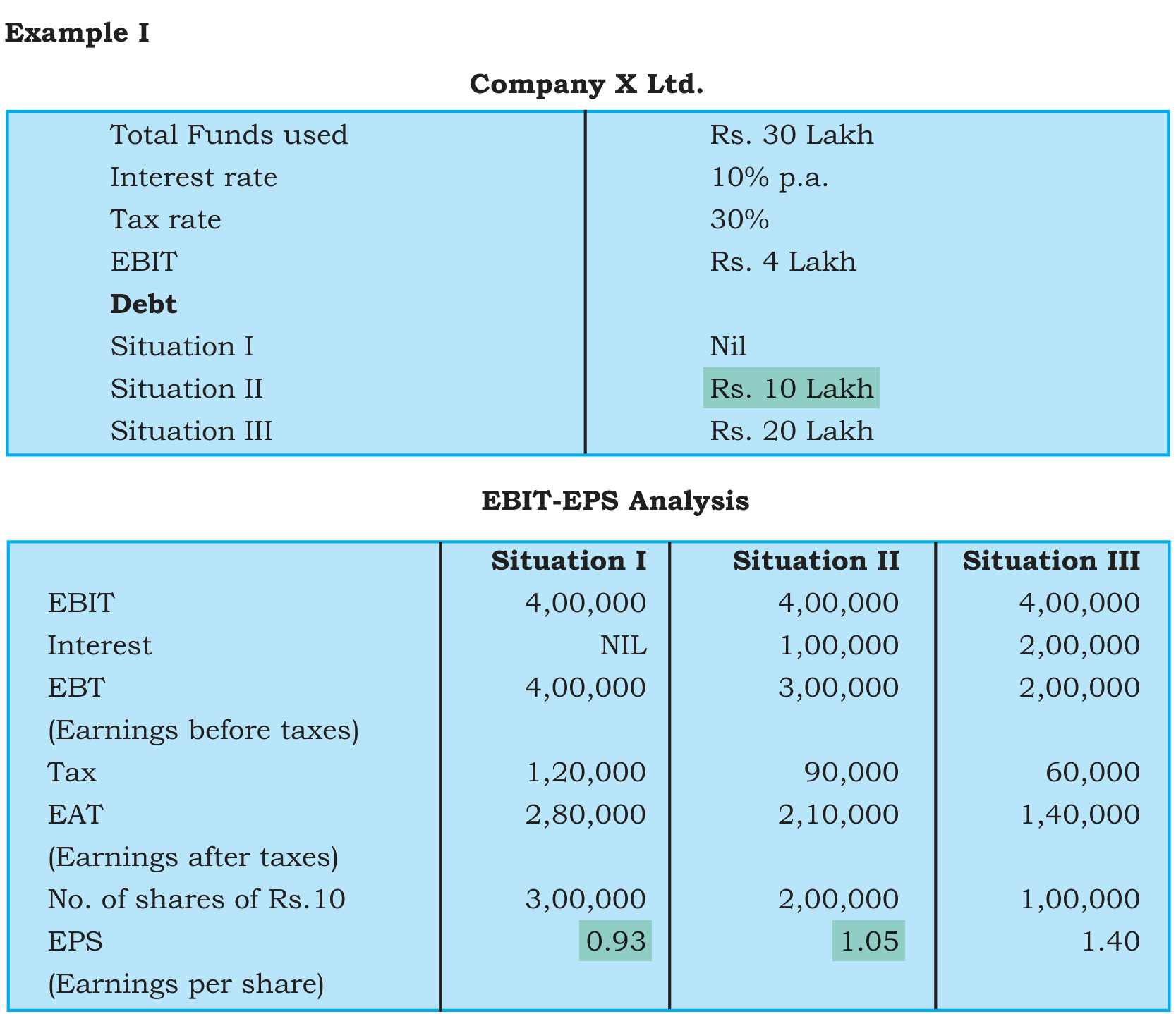
Answer the questions on the basis of the information given below.
Company X
TOTAL FUND USED = 30 LAKHS
| Face value of share | ₹10/- |
| Interest rate on Debt | 10% |
| Tax rate | 30% |
| EBIT | 4 Lakhs |
| Situation I (Debt) | Nil |
| Situation II (Debt) | 10 Lakhs |
Choose the correct answer from the options given below:
Identify the situation in which company X can avail the benefit of trading on equity.
Answer & explanation
Correct answer: option 2
The correct answer is Option (2) → Situation II
Trading on equity means using cheaper borrowed money (debt) to raise the profit of the equity shareholders. It helps only when the company earns more on its funds than the interest it pays on the debt. Company X earns EBIT of ₹4 lakh on total funds of ₹30 lakh. So its return on investment (RoI) is 4 ÷ 30 × 100 = 13.33%. The interest on debt is only 10%. Each rupee of debt earns more than it costs, and the extra profit goes to the equity shareholders. The EPS rises from ₹0.93 (no debt) to ₹1.05 (debt of ₹10 lakh).
Option (1) Situation I — Incorrect. In Situation I the debt is Nil. The whole ₹30 lakh comes from equity. Without debt there is no trading on equity.
Option (2) Situation II — Correct. The company uses debt of ₹10 lakh at 10% while it earns 13.33%. This is trading on equity.
Option (3) Both Situation I and Situation II — Incorrect. Situation I has no debt, so the benefit cannot come there.
Option (4) Neither Situation I nor Situation II — Incorrect. Situation II does give the benefit, because the RoI (13.33%) is more than the interest rate (10%).
Note: This case is based on the trading-on-equity example of Company X in NCERT Business Studies Part II, Chapter 9 (Financial Management). NCERT (2026-27 Edition): “Capital Structure … The company earns Rs. 0.93 per share if it is unlevered. With debt of Rs. 10 lakh its EPS is Rs. 1.05. With a still higher debt of Rs. 20 lakh, its, EPS rises to Rs. 1.40. Why is the EPS rising with higher debt? It is because the cost of debt is lower than the return that company is earning on funds employed. …” “Trading on Equity refers to the increase in profit earned by the equity shareholders due to the presence of fixed financial charges like interest.”
|