
CUETMOCK
  • Pricing
  • Mentors
Log inStart freeStart free mocks→

First test, then trust

Try a free CUET mock test.

Join 5,00,000+ students who rehearsed exam day on the exact NTA screen before sitting CUET. On the web and on Android.

Start free mocks →Get the Android app
CUETMOCK

India's #1 CUET Mock Test Platform. Original NCERT-based questions on the exact NTA exam screen — trusted by 5,00,000+ students since CUET 2022.

Get it onGoogle PlayScan to download the CUETMOCK app

Mock tests

  • CUET mock test series
  • Commerce mocks
  • Humanities (Arts) mocks
  • Science mocks
  • Languages & GAT mocks
  • Free practice questions
  • Pricing

Resources

  • CUET exam guide
  • CUET syllabus
  • Universities accepting CUET
  • Expert blogs
  • News & notifications
  • Webinars & counselling
  • CUET score calculator
  • How we estimate your rank
  • FAQs

Company

  • About us
  • Our leadership & team
  • Our toppers
  • Mentors
  • For schools
  • Contact us
  • Terms
  • Privacy
  • Refund policy

Talk to us

+91 7696 6630 56info@cuetmock.comWhatsApp us

Our other platforms

  • JEE Mock — For IIT-JEE aspirants
  • NEET Mock — For NEET aspirants

Newsletter

Exam updates, study material and offers — no spam.

© 2026 NYC Ventures Pvt. Ltd.

701-702, Royal Business Park, Zirakpur, Punjab - 140603

  • Terms of use
  • Privacy policy
  • Refund policy
  • Contact us

iCUETMOCK is an independent preparation platform, not affiliated with the National Testing Agency (NTA). Always check exam details on the official NTA website.

  • Home
  • Mock tests
  • CUET guide
  • Pricing
  • Log in
Home/Practice questions/Chemistry
ChemistryInorganic: D and F Block Elements

Statement I: Most of the compounds of the transition elements are col…

Statement I: Most of the compounds of the transition elements are coloured in the solid state and in solution.

Statement II: During a d–d transition, the electrons absorb certain radiation from the visible region of the spectrum.

Answer & explanation+

Correct answer: option 1

The correct answer is Option (1) → Statement I and statement II are true and statement II is correct explanation of statement I

Transition metal ions have partly filled d orbitals. Around the ion, the ligands (water molecules in solution, anions in a solid) split these d orbitals into sets of slightly different energy, so a d electron can jump from a lower to a higher d orbital.

Statement I: Most of the compounds of the transition elements are coloured in the solid state and in solution. — True. Formation of coloured ions is a typical property of the transition elements; for example, in aqueous solution \( \ce{Cu^2+} \) (3d9) is blue and \( \ce{Ni^2+} \) (3d8) is green. Ions with no d electron or a full d subshell, such as \( \ce{Sc^3+} \) (3d0) and \( \ce{Zn^2+} \) (3d10), are colourless, which is why the statement says “most”.

Statement II: During a d–d transition, the electrons absorb certain radiation from the visible region of the spectrum. — True. The energy gap between the split d orbitals matches light of a particular frequency, which generally lies in the visible region.

Why Statement II explains Statement I?

  • When white light falls on the compound, the d–d transition removes one part of the visible light, and the light that is left reaches the eye. The compound therefore shows the complementary colour of the light absorbed.

  • This absorption is the cause of the colour in Statement I, so Statement II is its correct explanation.

NCERT (2026-27 edition):
4.2 Electronic Configurations of the d-Block Elements – “… With partly filled d orbitals these elements exhibit certain characteristic properties such as display of a variety of oxidation states, formation of coloured ions and entering into complex formation with a variety of ligands.”

4.3.10 Formation of Coloured Ions – “When an electron from a lower energy d orbital is excited to a higher energy d orbital, the energy of excitation corresponds to the frequency of light absorbed (Unit 5). This frequency generally lies in the visible region. The colour observed corresponds to the complementary colour of the light absorbed. … In aqueous solutions where water molecules are the ligands, the colours of the ions observed are listed in Table 4.8.”

Table 4.8: Colours of Some of the First Row (aquated) Transition Metal Ions
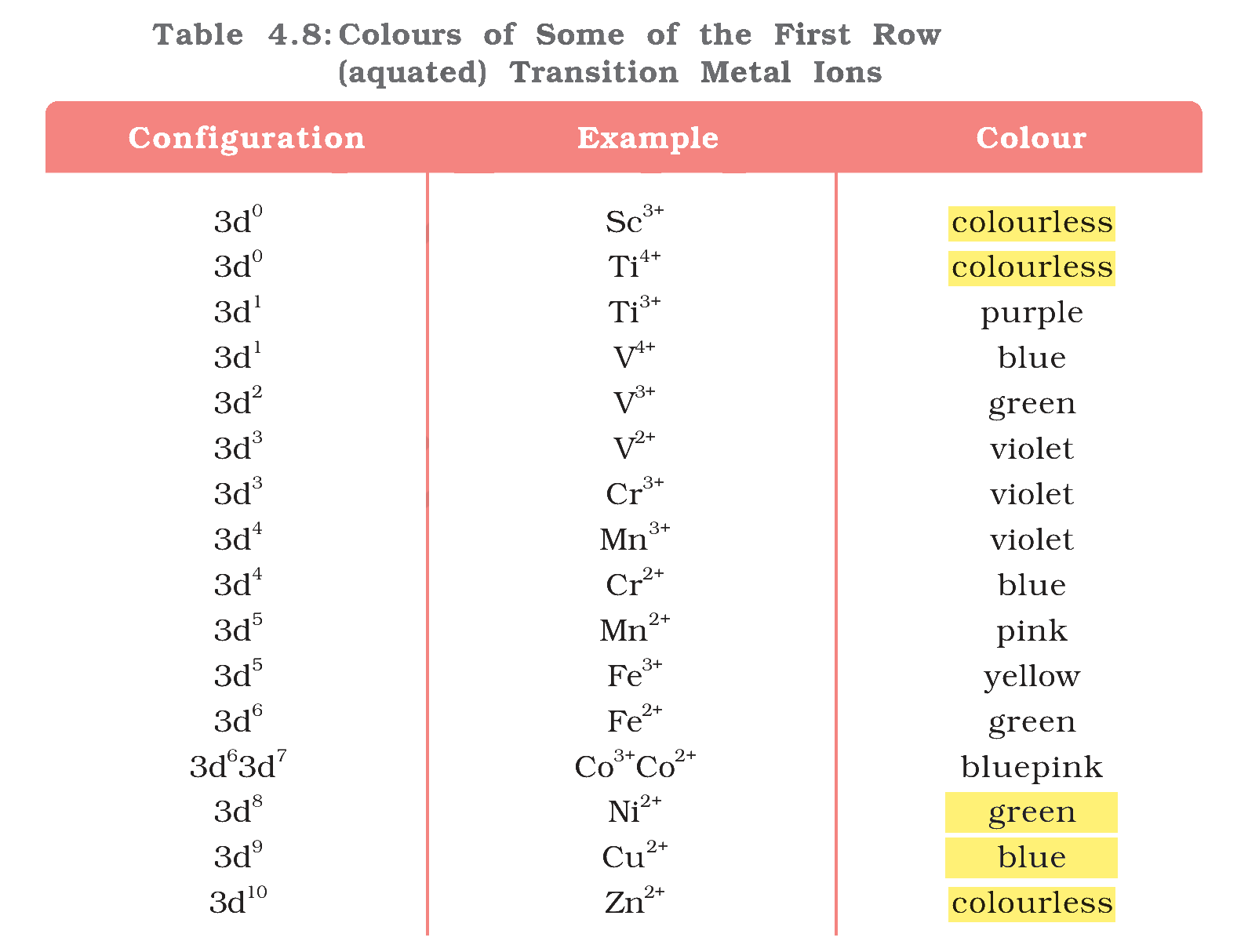
Table 4.8

Advertisement

Practise more on Inorganic: D and F Block Elements

Chapter-wise mocks on the real NTA exam screen, with solutions and your rank. Your first mocks are free.

Start free mocks →

Advertisement

Next questions

  1. <p style="text-align: justify;"><strong>"He has also given positional rights to people and often talks to subordinates to perform work and…Business Studies · Principles of Management
  2. Select the option in which numbers are related in the same way as are the numbers of following set. 8 : 73 : : 12 : ?General Aptitude Test · General Ability
  3. The equation of the family of curves which intersect the hyperbola x y=2 orthogonally isMaths. Section B1 · Differential Equations
  4. Three positive charges of equal value q are placed at the vertices of an equilateral triangle. The resulting electric field lines should be…Physics · Electric Charges and Fields
  5. Choose the word that is opposite in meaning to the given word. VivacityEnglish · Antonyms
  6. Let A and B be invertible square matrices of order 3. Consider the following statements: (A) A square matrix is invertible if and only if i…Maths. Section A · Determinants
  7. Paintings and patrons of the Golconda School. Arrange the following in the order in which they took place.(A) Muhammad Ali paints Poet in a…Fine Arts · The Deccani Schools of Painting
  8. In a one-sample t-test, a random sample of 9 observations gives t = 1.2. If a random sample of 36 observations had given the same sample me…Applied Maths. Section B2 · Inferential Statistics
  9. Choose the sentence that uses the correct question tag:English · Grammar: Question Tags
  10. Assertion (A): In the decomposition of hydrogen peroxide catalysed by iodide ion in an alkaline medium, IO− is an intermediate.Reason (R):…Chemistry · Physical: Chemical Kinetics