
CUETMOCK
  • Pricing
  • Mentors
Log inStart freeStart free mocks→

First test, then trust

Try a free CUET mock test.

Join 5,00,000+ students who rehearsed exam day on the exact NTA screen before sitting CUET. On the web and on Android.

Start free mocks →Get the Android app
CUETMOCK

India's #1 CUET Mock Test Platform. Original NCERT-based questions on the exact NTA exam screen — trusted by 5,00,000+ students since CUET 2022.

Get it onGoogle PlayScan to download the CUETMOCK app

Mock tests

  • CUET mock test series
  • Commerce mocks
  • Humanities (Arts) mocks
  • Science mocks
  • Languages & GAT mocks
  • Free practice questions
  • Pricing

Resources

  • CUET exam guide
  • CUET syllabus
  • Universities accepting CUET
  • Expert blogs
  • News & notifications
  • Webinars & counselling
  • CUET score calculator
  • How we estimate your rank
  • FAQs

Company

  • About us
  • Our leadership & team
  • Our toppers
  • Mentors
  • For schools
  • Contact us
  • Terms
  • Privacy
  • Refund policy

Talk to us

+91 7696 6630 56info@cuetmock.comWhatsApp us

Our other platforms

  • JEE Mock — For IIT-JEE aspirants
  • NEET Mock — For NEET aspirants

Newsletter

Exam updates, study material and offers — no spam.

© 2026 NYC Ventures Pvt. Ltd.

701-702, Royal Business Park, Zirakpur, Punjab - 140603

  • Terms of use
  • Privacy policy
  • Refund policy
  • Contact us

iCUETMOCK is an independent preparation platform, not affiliated with the National Testing Agency (NTA). Always check exam details on the official NTA website.

  • Home
  • Mock tests
  • CUET guide
  • Pricing
  • Log in
Home/Practice questions/Chemistry
ChemistryPhysical: Electro Chemistry

The statement “The amount of chemical reaction which occurs at any el…

The statement “The amount of chemical reaction which occurs at any electrode during electrolysis by a current is proportional to the quantity of electricity passed through the electrolyte” relates to which law?

Answer & explanation+

Correct answer: option 1

The correct answer is Option (1) → Faraday’s first law of electrolysis

Faraday’s first law of electrolysis links the chemical change at one electrode to the quantity of electricity passed:

    \( \displaystyle w=Z\,Q=Z\,I\,t \)

Here w is the mass deposited, Q the charge in coulombs (current I in amperes × time t in seconds) and Z the electrochemical equivalent. The second law, in contrast, compares different substances liberated by the same charge.

NCERT (2026-27 edition):
Quantitative Aspects of Electrolysis
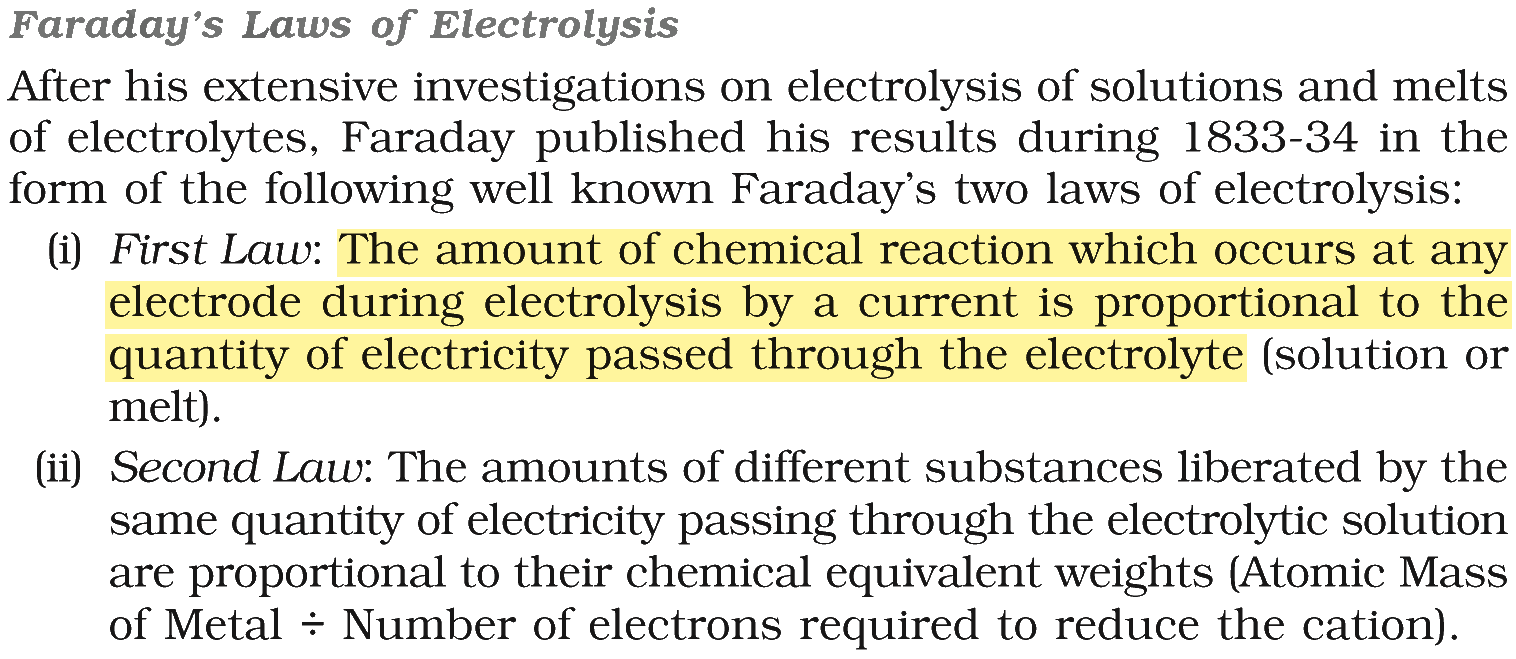
Textbook extract

Advertisement

Practise more on Physical: Electro Chemistry

Chapter-wise mocks on the real NTA exam screen, with solutions and your rank. Your first mocks are free.

Start free mocks →

Advertisement

Next questions

  1. Arrange the following events in chronological order:A. National Front government’s decision to implement a key recommendation of the Mandal…Political Science · Politics in India Since Independence: Recent Developments in Indian Politics
  2. A charge q is placed at the center of a line joining two equal positive charges Q. The system of the three charges will be in equilibrium,…Physics · Electric Charges and Fields
  3. Raven’s Progressive Matrices (RPM) Test is an example of__________ test.Psychology · Variations in Psychological Attributes
  4. “These new and revolutionary changes in China and India, even though they differ in content, symbolise the new spirit of Asia and new vital…Economics · Indian Economic Development: Comparative Development Experiences of India and its Neighbours
  5. Arrange the following materials in the increasing order of their energy band gaps.A. GermaniumB. MetalC. CarbonD. SiliconChoose the correct…Physics · Semiconductors and Electronic Devices
  6. What event led to the naming of the cricket series as "The Ashes"?English · Comprehension - (Narrative / Factual)
  7. What medium did the artist use in his art work?Fine Arts · The Modern Indian Art
  8. Expansion of transportation and communication facilities fall under which dimension of Business Environment?Business Studies · Business Environment
  9. Match the LIST-I with LIST-IILIST-ILIST-IIA.Tax revenueI.Interest receiptsB.Non-tax revenueII.Sale of shares in Public Sector UnitsC.Capita…Economics · Macro Economics: Government Budget and Economy
  10. Comparative statements in financial analysis are also known as:Accountancy Part B · Analysis of Financial Statements