Benzylamine may be alkylated as shown in the following equation:
C6H5CH2NH2 + R–X → C6H5CH2NHR
Which of the following halides is best suited for this reaction by the SN1 mechanism?
Answer & explanation
Correct answer: option 3
The correct answer is Option (3) → C6H5CH2Br
In an SN1 reaction the slow step is the loss of the halide ion to form a carbocation. The more stable the carbocation, the faster it forms and the faster the reaction.
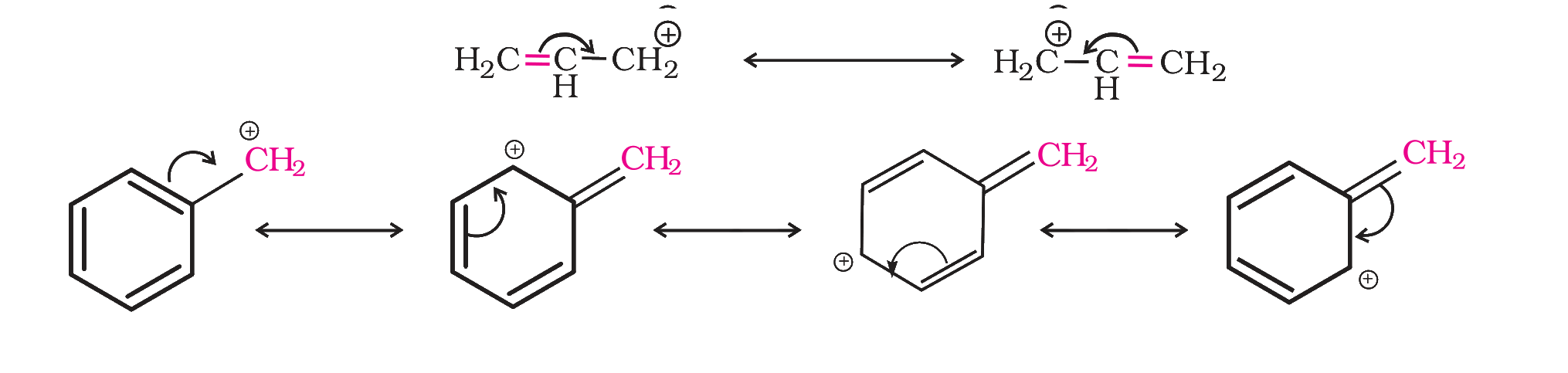
Benzyl bromide ionises to the benzyl carbocation, \( \ce{C6H5CH2^+} \), whose positive charge is spread over the ring by resonance. This makes it the best SN1 substrate here:
\( \displaystyle \ce{C6H5CH2NH2 + C6H5CH2Br -> C6H5CH2NHCH2C6H5 + HBr} \)
Why the other options are incorrect
Option (1) CH3Br — Incorrect. The methyl carbocation is the least stable carbocation, so CH3Br reacts by the SN2 path, not SN1.
Option (2) C2H5Br — Incorrect. It is a primary halide; its carbocation has no resonance stabilisation, so it also prefers SN2.
Option (4) C6H5Br — Incorrect. In an aryl halide the phenyl cation formed would not be stabilised by resonance, so the SN1 mechanism is ruled out.
NCERT (2026-27 edition):
6.7.1 Reactions of Haloalkanes – “… allylic and benzylic halides show high reactivity towards the SN1 reaction. The carbocation thus formed gets stabilised through resonance …”