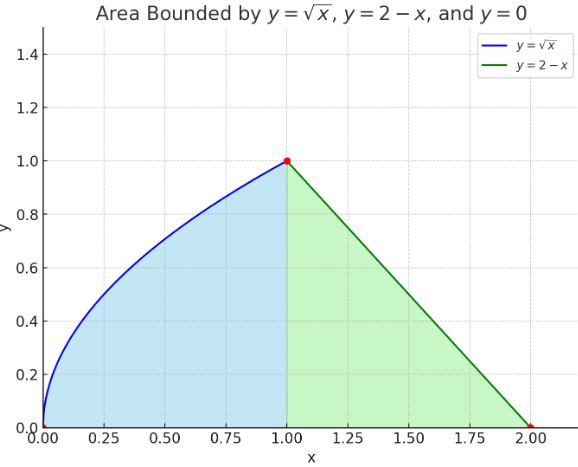
Area of the region bounded by the curve $y = \sqrt{x}$ and lines $x + y = 2, y = 0$ is
Answer & explanation
Correct answer: option 3
The correct answer is Option (3) → $\frac{7}{6}$ square units
The region is bounded by the curves:
-
$y = \sqrt{x}$
-
$x + y = 2 \Rightarrow y = 2 - x$
-
$y = 0$
To find the area, find the points of intersection:
Intersection of $y = \sqrt{x}$ and $y = 2 - x$:
$\sqrt{x} = 2 - x \Rightarrow x + \sqrt{x} - 2 = 0$
Substitute $\sqrt{x} = t \Rightarrow x = t^2$
$\Rightarrow t^2 + t - 2 = 0 \Rightarrow (t + 2)(t - 1) = 0$
$\Rightarrow t = 1 \Rightarrow x = 1$, so intersection point is $(1,1)$
Other boundary: $x + y = 2$ intersects $y = 0$ at $x = 2 \Rightarrow (2,0)$
$y = \sqrt{x}$ intersects $y = 0$ at $x = 0 \Rightarrow (0,0)$
Split the region into two parts:
-
Region I (under $y = \sqrt{x}$ from $x = 0$ to $x = 1$)
$A_1 = \int_0^1 \sqrt{x} \, dx = \left[\frac{2}{3}x^{3/2}\right]_0^1 = \frac{2}{3}$
-
Region II (under $y = 2 - x$ from $x = 1$ to $x = 2$)
$A_2 = \int_1^2 (2 - x) \, dx = \left[2x - \frac{x^2}{2}\right]_1^2$
$= (4 - 2) - (2 - \frac{1}{2}) = 2 - \frac{3}{2} = \frac{1}{2}$
Total Area = $A_1 + A_2 = \frac{2}{3} + \frac{1}{2} = \frac{4 + 3}{6} = \frac{7}{6}$