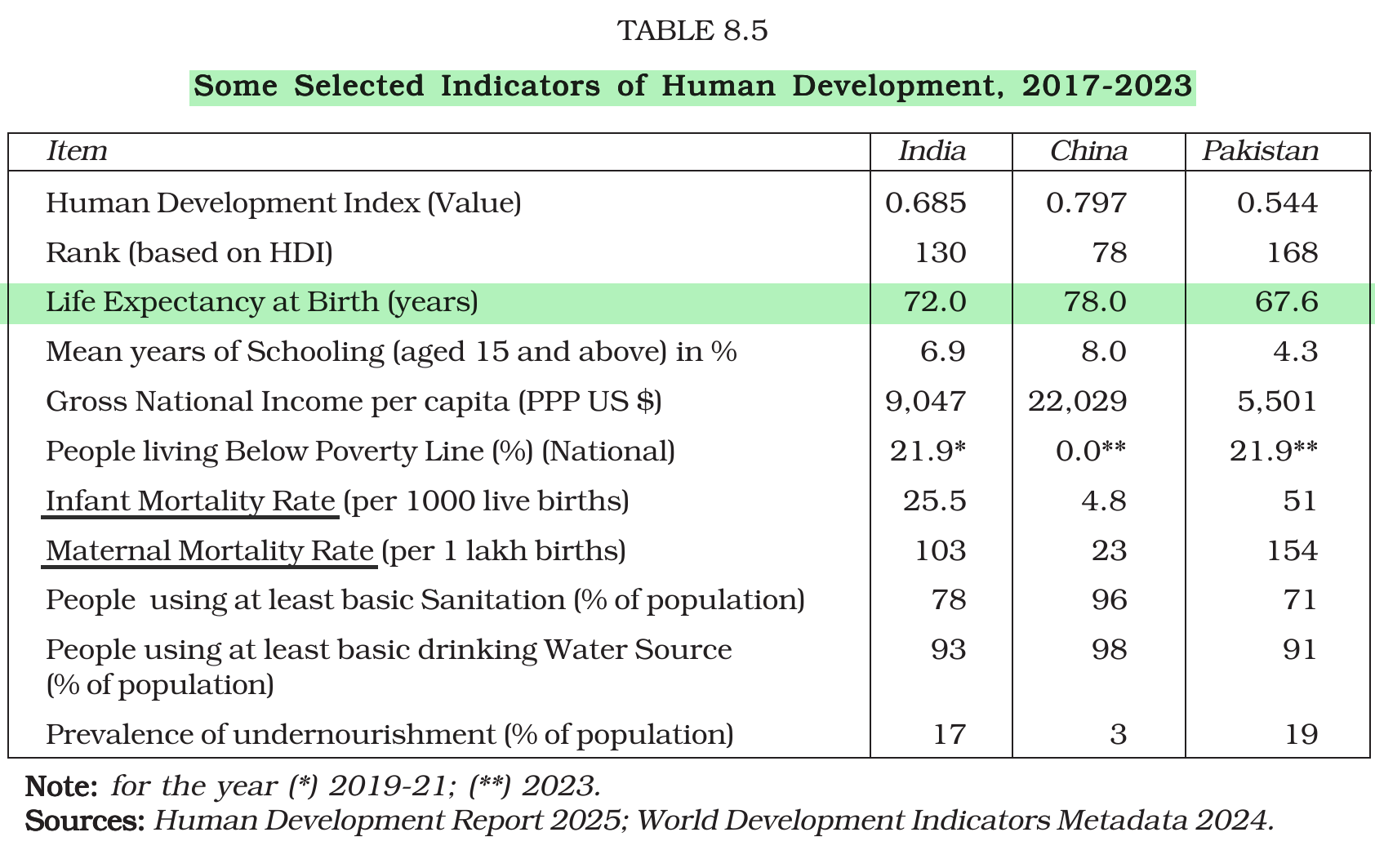
It is estimated as the number of years a newborn infant would live if prevailing patterns of age-specific mortality rates at the time of birth were to stay the same throughout the child's life. Identify the concept, which is one of the indicators of the Human Development Index.
Answer & explanation
Correct answer: option 2
The correct answer is Option (2) → Life Expectancy at Birth (year)
The description gives the number of years a newborn baby is expected to live. That is life expectancy at birth. It stands for a long and healthy life, one of the indicators of human development.
Option (1) Infant Mortality Rate — Incorrect. It counts the babies who die before their first birthday, out of every 1,000 born alive. It is a number of deaths, not a number of years.
Option (2) Life Expectancy at Birth (year) — Correct. It is measured in years of life, as the description says.
Option (3) Morbidity Rate — Incorrect. Morbidity means proneness to fall ill. The rate shows how much illness there is in a population, not how long people live.
Option (4) Maternal Mortality rate — Incorrect. It counts the women who die from causes linked to pregnancy and childbirth, out of every one lakh live births.
NCERT (2026-27): “8.5 Indicators of Human Development You might have studied about the importance of human development indicators in the lower classes and the position of many developed and developing countries. Let us look how India, China and Pakistan have performed in some of the select indicators of human development. …… …Table 8.5 shows that China is moving ahead of India and Pakistan. This is true for many indicators — income indicator such as GDP per capita, or proportion of population below poverty line or health indicators such as mortality rates, access to sanitation, literacy, life expectancy or malnourishment.…”
|