
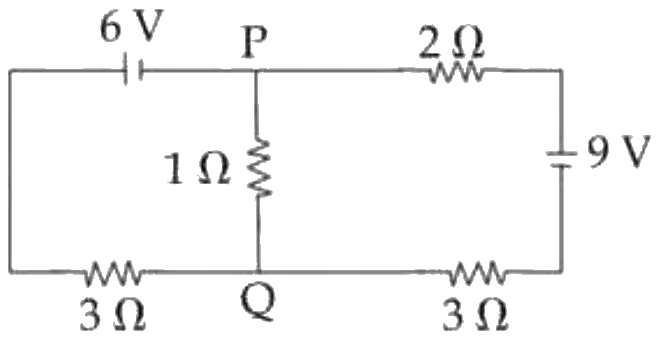
In the circuit shown below the current in the \( 1\,\Omega \) resistor is :
Answer & explanation
Correct answer: option 3
The correct answer is Option (3) → 0.13 A from Q to P
The circuit has three branches between the junctions P and Q, so use Kirchhoff's junction rule with the potentials of the junctions.
Take \( V_Q = 0 \) and \( V_P = x \). Readings from the figure:
\( \text{left branch: } 6\,\mathrm{V} \text{ cell (positive plate away from P) and } 3\,\Omega \)
\( \text{middle branch: } 1\,\Omega \)
\( \text{right branch: } 2\,\Omega,\ 9\,\mathrm{V} \text{ cell (positive plate towards P) and } 3\,\Omega \)
Let each branch current flow from P to Q.
Left branch: going from P through the 6 V cell (negative to positive) the potential rises by 6 V, then falls across \( 3\,\Omega \):
\( \displaystyle x + 6 - 3i_1 = 0 \;\Rightarrow\; i_1 = \frac{x + 6}{3} \)
Right branch: the potential falls across \( 2\,\Omega \), falls by 9 V through the cell (positive to negative), then falls across \( 3\,\Omega \):
\( \displaystyle x - 2i_2 - 9 - 3i_2 = 0 \;\Rightarrow\; i_2 = \frac{x - 9}{5} \)
Middle branch:
\( i_3 = x/1 = x \)
The total current leaving P is zero (junction rule):
\( \displaystyle \frac{x + 6}{3} + \frac{x - 9}{5} + x = 0 \)
Multiplying by 15,
\( 5x + 30 + 3x - 27 + 15x = 0 \)
\( 23x = -3 \)
\( x = -0.13\,\mathrm{V} \)
\( \displaystyle i_3 = \frac{V_P - V_Q}{1\,\Omega} = -0.13\,\mathrm{A} \)
The negative sign means the current in the \( 1\,\Omega \) resistor flows from Q to P, and its size is 0.13 A.