CUETMOCK
  • Pricing
  • Mentors
Log inStart freeStart free mocks→

First test, then trust

Try a free CUET mock test.

Join 5,00,000+ students who rehearsed exam day on the exact NTA screen before sitting CUET. On the web and on Android.

Start free mocks →Get the Android app
CUETMOCK

India's #1 CUET Mock Test Platform. Original NCERT-based questions on the exact NTA exam screen — trusted by 5,00,000+ students since CUET 2022.

Get it onGoogle PlayScan to download the CUETMOCK app

Mock tests

  • CUET mock test series
  • Browse all papers
  • Commerce mocks
  • Humanities (Arts) mocks
  • Science mocks
  • Languages & GAT mocks
  • Free practice questions
  • Pricing

Resources

  • CUET exam guide
  • CUET syllabus
  • Universities accepting CUET
  • Expert blogs
  • News & notifications
  • Webinars & counselling
  • CUET score calculator
  • How we estimate your rank
  • FAQs

Company

  • About us
  • Our leadership & team
  • Our toppers
  • Mentors
  • For schools
  • Contact us
  • Terms
  • Privacy
  • Refund policy

Talk to us

+91 7696 6630 56info@cuetmock.comWhatsApp us

Our other platforms

  • JEE Mock — For IIT-JEE aspirants
  • NEET Mock — For NEET aspirants

Newsletter

Exam updates, study material and offers — no spam.

© 2026 NYC Ventures Pvt. Ltd.

701-702, Royal Business Park, Zirakpur, Punjab - 140603

  • Terms of use
  • Privacy policy
  • Refund policy
  • Contact us

iCUETMOCK is an independent preparation platform, not affiliated with the National Testing Agency (NTA). Always check exam details on the official NTA website.

  • Home
  • Mock tests
  • CUET guide
  • Pricing
  • Log in
Home/Practice questions/Chemistry
ChemistryOrganic: Haloalkanes and Haloarenes

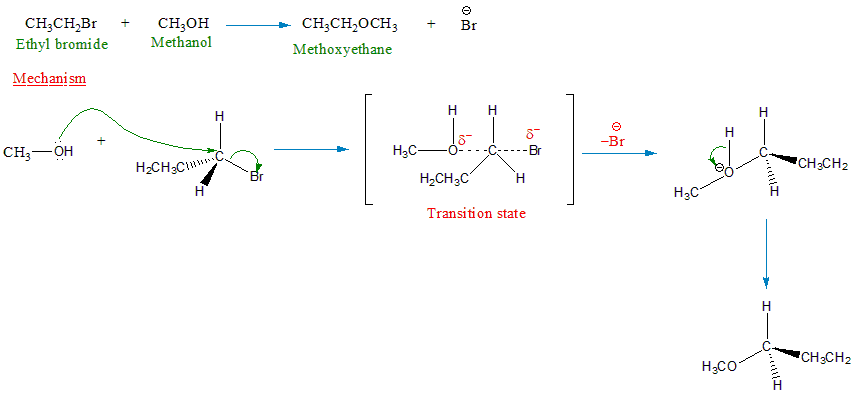
What is the product of the given reaction?

The halogen atom in haloalkanes is more electronegative than the carbon atom attached to it. As a result, the atom acquires a partial positive charge and the halogen atom a partial negative charge.
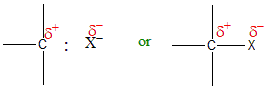
The presence of this small positive charge on the carbon atom makes it susceptible to attack by nucleophilic reagents. Thus, when a nucleophile stronger than the halide ion approaches the positively charged carbon atom of an alkylhalide, the halogen atom with its bonding pair of electrons is displaced and a new bond between the carbon atom and the incoming nucleophile is formed:

Such reactions in which a stronger nucleophile displaces a weaker nucleophile are called nucleophilic substitution reactions and the atom or group which departs with its bonding pair of electrons is called leaving group. The better the leaving group, the more facile the nucleophilic substitution reaction.

Amongst the halide ions, the order in which the leaving group departs follows the sequence:

\[I^− > Br^− > Cl^− > F^−\]

It is because of this reason that the order of reactivity of haloalkanes follows the sequence:

\[iodoalkanes > bromoalkanes > chloroalkanes > fluoroalkanes\]

There are two types of nucleophilic substitution reactions. These are:

(a)   Substitution Nucleophilic Bimolecular (SN2)

(b)   Substitution Nucleophilic Unimolecular (SN1)

What is the product of the given reaction?

Answer & explanation+

Correct answer: option 2

Advertisement

Practise more on Organic: Haloalkanes and Haloarenes

Chapter-wise mocks on the real NTA exam screen, with solutions and your rank. Your first mocks are free.

Start free mocks →

Advertisement

Next questions

  1. Which among the following explains the origin of the universe?Biology · Evolution
  2. Which of the following statements is/are true regarding Princely states after the partition of India? 1. The British government took the vi…Political Science · Politics in India Since Independence: Challenges of nation Building
  3. If I=∫(√tanx+√cotx)dx = f(x) + c then f(x) is equal toMaths. Section A · Definite Integration
  4. Brass is an alloy and it is a mixture of _____?General Aptitude Test · General Knowledge
  5. What distinguishes the benefits of human capital from those of physical capital?Economics · Indian Economic Development: Human Capital Formation in India
  6. Complete the series: 12, 20, 30, 42, 56, ?General Aptitude Test · Verbal Reasoning
  7. Who is the author of the book -God of Small Things?General Aptitude Test · General Knowledge
  8. Buddhism was divided into Mahayana and Hinayana during which Buddhist Council?General Aptitude Test · General Knowledge
  9. It took only _____ years for world population to rise from 5 billion to 6 billion.Geography · Fundamentals of Human Geography: World Population-Distribution, Density and growth
  10. How does globalisation affect traditional conceptions of state sovereignty?Political Science · Contemporary World Politics: Globalisation