Which of the following gives the correct representation of zwitter ion of the given amino acid ?
Answer & explanation
Correct answer: option 2
The correct answer is Option (2) → H2N–CH(CH3)–COOH → H3N+–CH(CH3)–COO−
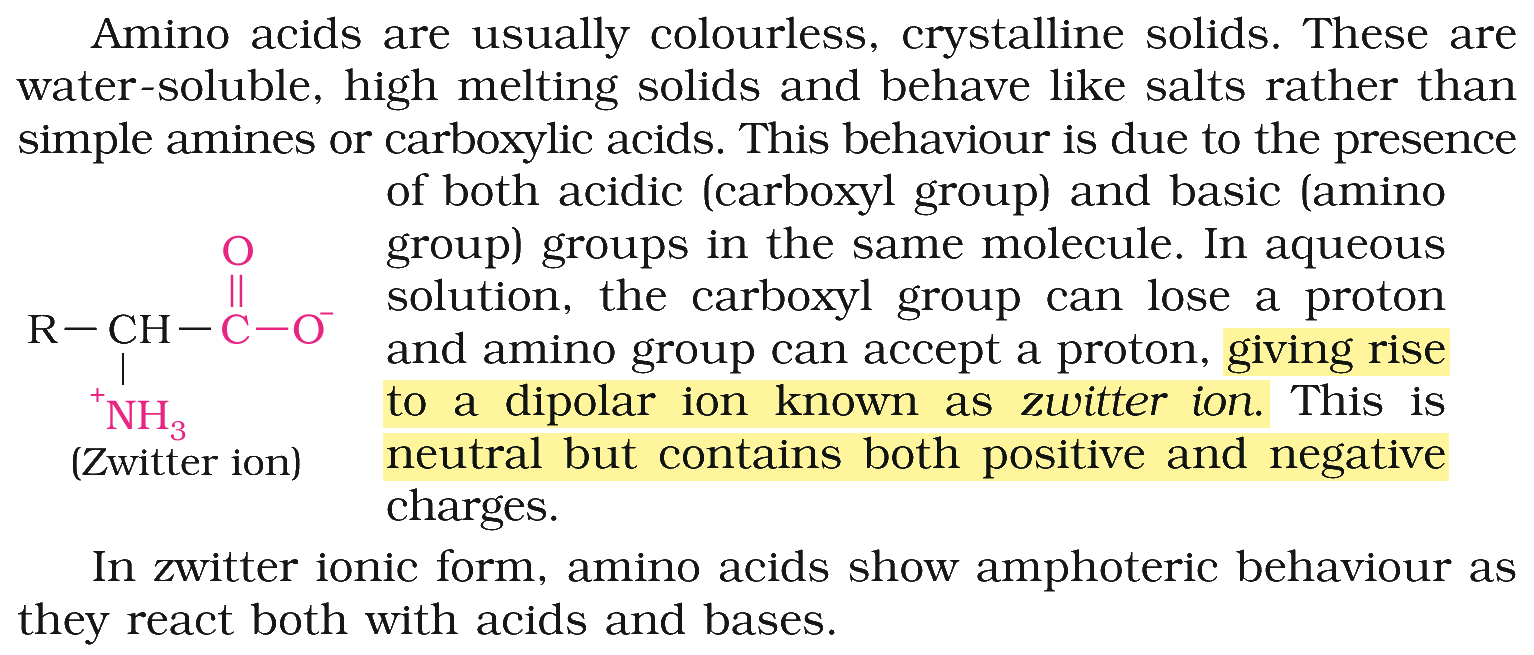
An amino acid has a basic amino group and an acidic carboxyl group in the same molecule. In aqueous solution the carboxyl group gives up a proton and the amino group accepts it. The result is a dipolar ion, called a zwitter ion, which carries a positive charge on nitrogen and a negative charge on oxygen but carries no net charge.
For the given amino acid (alanine):
\( \displaystyle \ce{H2N-CH(CH3)-COOH -> H3N^+-CH(CH3)-COO^-} \)
So the zwitter ion is H3N+–CH(CH3)–COO−, in which both the –\( \ce{NH3^{+}} \) and the –\( \ce{COO^{-}} \) groups are present.
Why the other options are incorrect
Option (1) unchanged amino acid on both sides — Incorrect. No proton has moved, so there is no charge separation at all.
Option (3) H2N–CH(CH3)–COO− — Incorrect. Only the negative charge is present. This is the anion form, which predominates in basic solution.
Option (4) H3N+–CH(CH3)–COOH — Incorrect. Only the positive charge is present. This is the cation form, which predominates in acidic solution.
NCERT (2026-27 edition):
Classification of Amino Acids – …