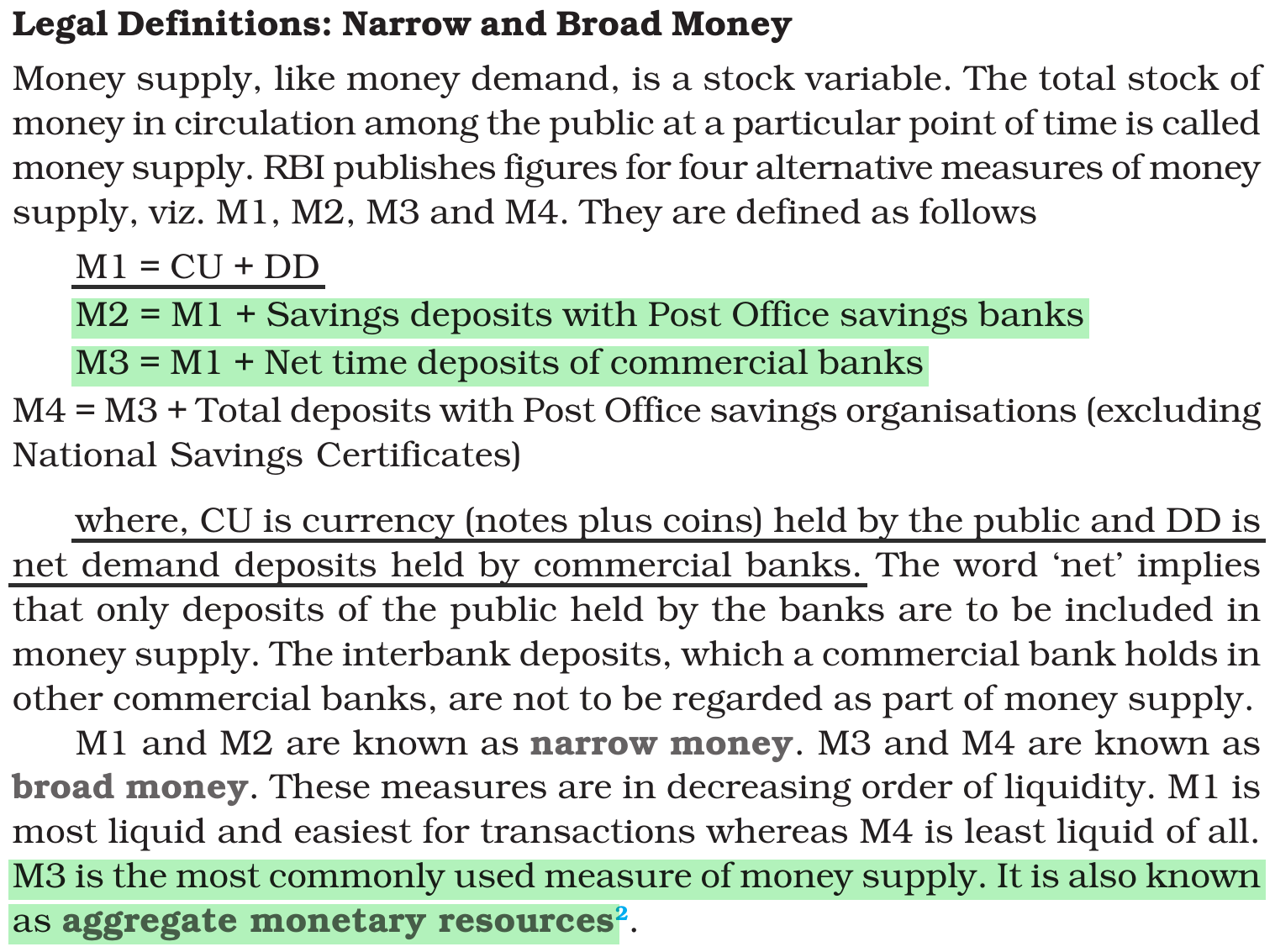
M3 is the most commonly used measure of money supply. It is also known as aggregate monetary resources. Which of the following is not a component of M3?
Answer & explanation
Correct answer: option 3
The correct answer is Option (3) → Savings deposits with Post Office savings banks.
Savings deposits with Post Office savings banks are counted in M2, so they are not a part of M3. M3 = M1 + net time deposits of commercial banks. M1 is currency held by the public plus net demand deposits held by commercial banks.
Option (1) Currency held by public. — Part of M3 (Incorrect). Notes and coins held by the public are part of M1, and M1 is inside M3.
Option (2) Demand deposits by people with commercial banks. — Part of M3 (Incorrect). Demand deposits are also part of M1.
Option (3) Savings deposits with Post Office savings banks. — Not a part of M3 (Correct). These deposits are added to M1 to get M2. M3 is built from M1 with a different item.
Option (4) Net time deposits of commercial banks. — Part of M3 (Incorrect). This is the item that is added to M1 to get M3.
NCERT (2026-27): Introductory Macroeconomics — Chapter 3: Money and Banking
|