
Answer the question on the basis of passage given below:
There are three kinds of amines which are primary, secondary and tertiary amines. These amines may have alkyl group or aryl group or both alkyl and aryl groups. These amines can be distinguished from one another by various chemical tests.
An amine \(A\) on treatment with \(NaNO_2\) and \(HCl\) at \(273-277 K\), followed by treatment with ethyl alcohol gives a compound \(B\) with an empirical formula of \(CH\) and molecular mass \(78\), \(A\) is:
Answer & explanation
Correct answer: option 2
The correct answer is option 2. 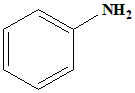
Given that the empirical formula of compound \(B\) is \(CH\) and its molecular mass is \(78\), we have to consider that the compound must contain one carbon atom and one hydrogen atom, with a total molecular mass of \(12 \, (\text{C}) + 1 \, (\text{H}) = 13 \, \text{g/mol}\). Thus total number of \(CH\) atoms
\(= \frac{\text{Molecular mass}}{\text{empirical mass}}\)
\(= \frac{78}{13} = 6\)
Thus, the compound has \(6\) \(CH\) atoms. So, the compound may be benzene.
Now, to find the amine \(A\), which upon treatment with \(NaNO_2\) and \(HCl\) followed by reaction with ethyl alcohol (\(C_2H_5OH\)), gives this compound, we should look for an amine that can undergo diazotization followed by replacement with ethyl alcohol to yield benzene.
The amine that fits these criteria is aniline, \(C_6H_5NH_2\).
Here's how the reaction proceeds:
1. Aniline (\(C_6H_5NH_2\)) reacts with \(NaNO_2\) and \(HCl\) to form the diazonium salt of aniline, \(C_6H_5N_2^+\)
2. The diazonium salt then reacts with ethyl alcohol (\(C_2H_5OH\)) to replace the diazonium group, forming ethylbenzene (\(C_6H_5CH_2OH\)).
Therefore, the correct answer is \(C_6H_5NH_2\) (Aniline).
