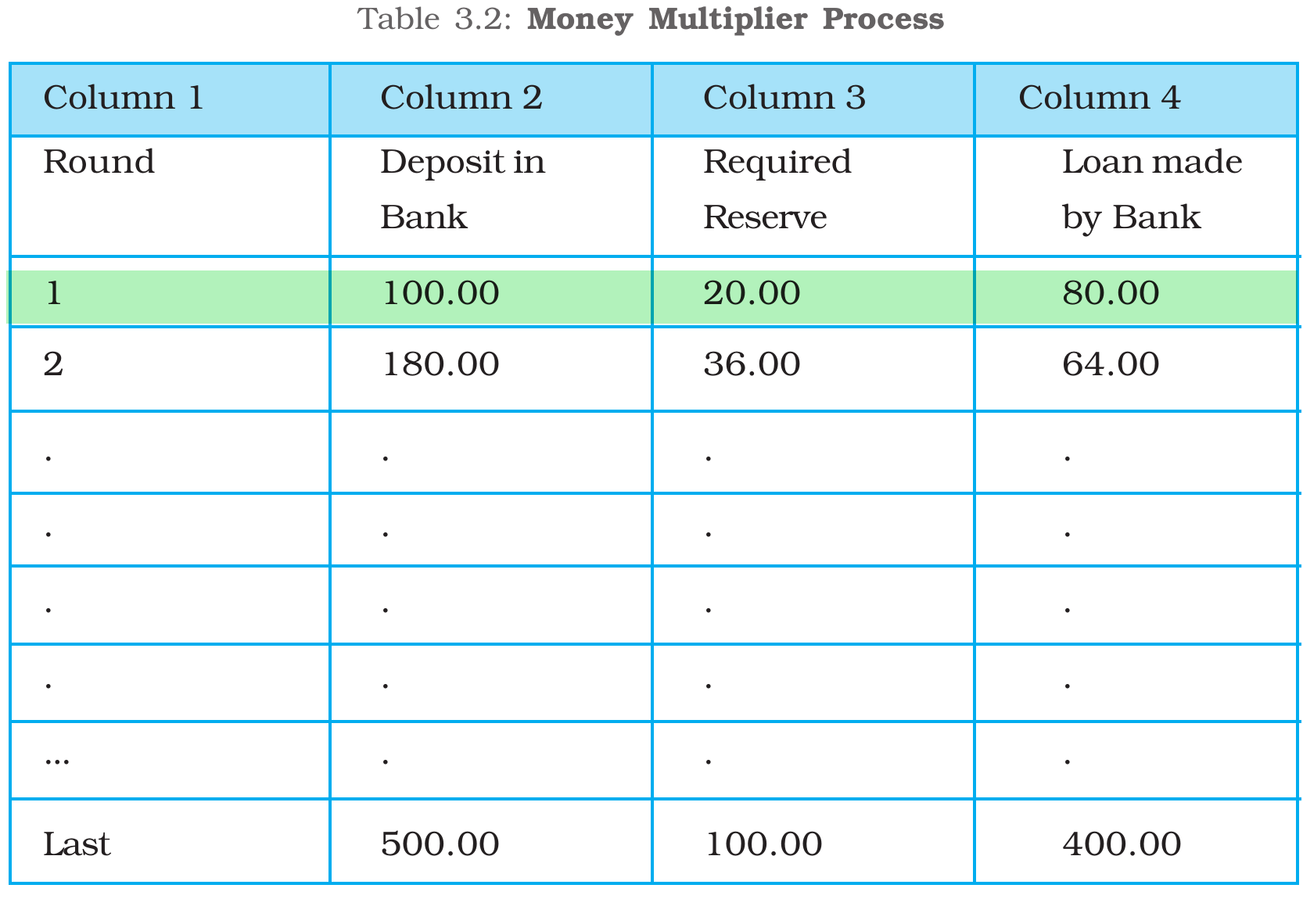
Suppose, in a hypothetical economy, the cash reserve ratio is 20% and initial deposits are Rs.100. The value of money which a bank can use to give as a loan in the first round would be
Answer & explanation
Correct answer: option 1
The correct answer is Option (1) → 80
Given:
Cash reserve ratio = 20%
Initial deposits = Rs. 100
The cash reserve ratio (CRR) is the percentage of deposits that a bank must keep as cash reserves. It can give the rest as a loan.
Cash reserves = 20% of 100 = Rs. 20
Loan in the first round = 100 − 20 = Rs. 80
Note: The figures of this question are the first round of the money multiplier example in the chapter ‘Money and Banking’ of the NCERT book, unchanged.
NCERT (2026-27): “3.3.2 Limits to Credit Creation and Money Multiplier … Cash Reserve Ratio (CRR) = Percentage of deposits which a bank must keep as cash reserves with the bank. … … In our fictional example, suppose CRR = 20 per cent, then with deposits of Rs 100, our bank will need to keep Rs 20 (20 per cent of 100) as cash reserves. Only the remaining amount of deposits, i.e., Rs 80 (100 – 20 = 80) can be used to give loans. The statutory requirement of the reserve ratio acts as a limit to the amount of credit that banks can create.”
|