CUETMOCK
  • Pricing
  • Mentors
Log inStart freeStart free mocks→

First test, then trust

Try a free CUET mock test.

Join 5,00,000+ students who rehearsed exam day on the exact NTA screen before sitting CUET. On the web and on Android.

Start free mocks →Get the Android app
CUETMOCK

India's #1 CUET Mock Test Platform. Original NCERT-based questions on the exact NTA exam screen — trusted by 5,00,000+ students since CUET 2022.

Get it onGoogle PlayScan to download the CUETMOCK app

Mock tests

  • CUET mock test series
  • Browse all papers
  • Commerce mocks
  • Humanities (Arts) mocks
  • Science mocks
  • Languages & GAT mocks
  • Free practice questions
  • Pricing

Resources

  • CUET exam guide
  • CUET syllabus
  • Universities accepting CUET
  • Expert blogs
  • News & notifications
  • Webinars & counselling
  • CUET score calculator
  • How we estimate your rank
  • FAQs

Company

  • About us
  • Our leadership & team
  • Our toppers
  • Mentors
  • For schools
  • Contact us
  • Terms
  • Privacy
  • Refund policy

Talk to us

+91 7696 6630 56info@cuetmock.comWhatsApp us

Our other platforms

  • JEE Mock — For IIT-JEE aspirants
  • NEET Mock — For NEET aspirants

Newsletter

Exam updates, study material and offers — no spam.

© 2026 NYC Ventures Pvt. Ltd.

701-702, Royal Business Park, Zirakpur, Punjab - 140603

  • Terms of use
  • Privacy policy
  • Refund policy
  • Contact us

iCUETMOCK is an independent preparation platform, not affiliated with the National Testing Agency (NTA). Always check exam details on the official NTA website.

  • Home
  • Mock tests
  • CUET guide
  • Pricing
  • Log in
Home/Practice questions/General Aptitude Test
General Aptitude TestVerbal ReasoningSyllogism

Two statements are given, followed by three conclusions numbered I, I…

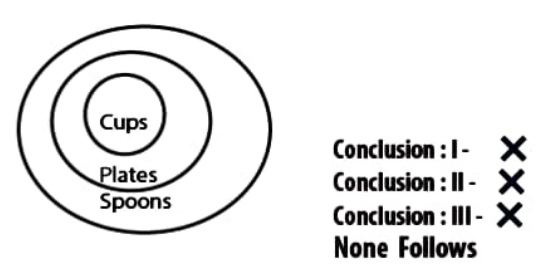
Two statements are given, followed by three conclusions numbered I, II and III. Assuming the statements to be true, even if they seem to be at variance with commonly known facts, decide which of the conclusions logically follow(s) from the statements.

Statements:

All cups are plates.

All plates are spoons.

Conclusions:

I. All plates are cups.

II. Some spoons are neither plates nor cups.

III. No spoon is a cup.

Answer & explanation+

Correct answer: option 3

Advertisement

Practise more on Verbal Reasoning

Chapter-wise mocks on the real NTA exam screen, with solutions and your rank. Your first mocks are free.

Start free mocks →

Advertisement

Next questions

  1. Find out the number of students who play only cricket?General Aptitude Test · Verbal Reasoning
  2. If A is a matrix of order 2, and |adj A| = -2, then which of the following statements is true for |A|?Maths. Section B1 · Determinants
  3. Which one of the following forms of settlement develops along either side of roads, rivers or canals?Geography · Fundamentals of Human Geography: Human Settlements
  4. A train crosses a 400 m-long platform in 50 seconds. It crosses another 600 m-long platform in 60 seconds. What are the length and the spee…General Aptitude Test · Numerical Ability
  5. Chemistry · Inorganic: Coordination Compounds
  6. What is the last step in the controlling process?Business Studies · Controlling
  7. Heat reaches earth by which of the following process?General Aptitude Test · General Knowledge
  8. 'जिसकी बुद्धि कुशा के अग्रभाग के समान तीव्र हो' वाक्यांश के लिए एक शब्द है -Hindi · वाक्यांशों के लिए एक शब्द
  9. What term is used to describe the part of the Western Indian School that depicts Jain themes and manuscripts?Fine Arts · The Manuscript Painting Tradition
  10. Where is the Abhisarika Nayika of Kangra, dating from 1810–20, currently located?Fine Arts · The Pahari Schools of Painting