The rate of change of volume of a sphere with respect to its surface area, when radius is 4 cm, is equal to
Answer & explanation
Correct answer: option 4
The correct answer is Option (4) → 2 cm3/cm2
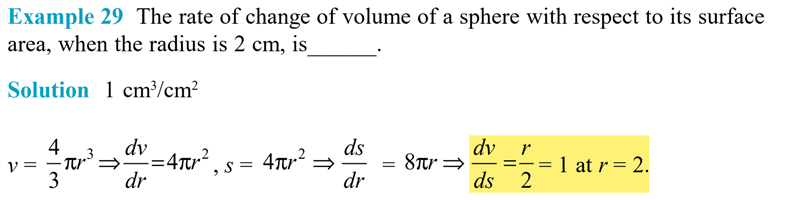
Let r be the radius. The volume and the surface area are
\(\displaystyle V = \frac{4}{3}\pi r^3,\quad S = 4\pi r^2\)
Both depend on r, so by the chain rule
\(\displaystyle \frac{dV}{dS} = \frac{dV/dr}{dS/dr}\)
\(\displaystyle \frac{dV}{dr} = 4\pi r^2,\quad \frac{dS}{dr} = 8\pi r\)
\(\displaystyle \frac{dV}{dS} = \frac{4\pi r^2}{8\pi r} = \frac{r}{2}\)
At r = 4 cm:
\(\displaystyle \frac{dV}{dS} = \frac{4}{2} = 2\) cm3/cm2
Why the other options are incorrect
Option (1) \(64\pi\) cm3/cm2 — Incorrect. This is \(\frac{dV}{dr} = 4\pi(4)^2 = 64\pi\), the rate of change of volume with respect to the radius.
Option (2) \(32\pi\) cm3/cm2 — Incorrect. This is \(\frac{dS}{dr} = 8\pi(4) = 32\pi\), the rate of change of surface area with respect to the radius.
Option (3) \(\frac{1}{2}\) cm3/cm2 — Incorrect. This is \(\frac{dS}{dV} = \frac{2}{r} = \frac{1}{2}\), the rate taken the other way round.
NCERT Exemplar:
Application of Derivatives