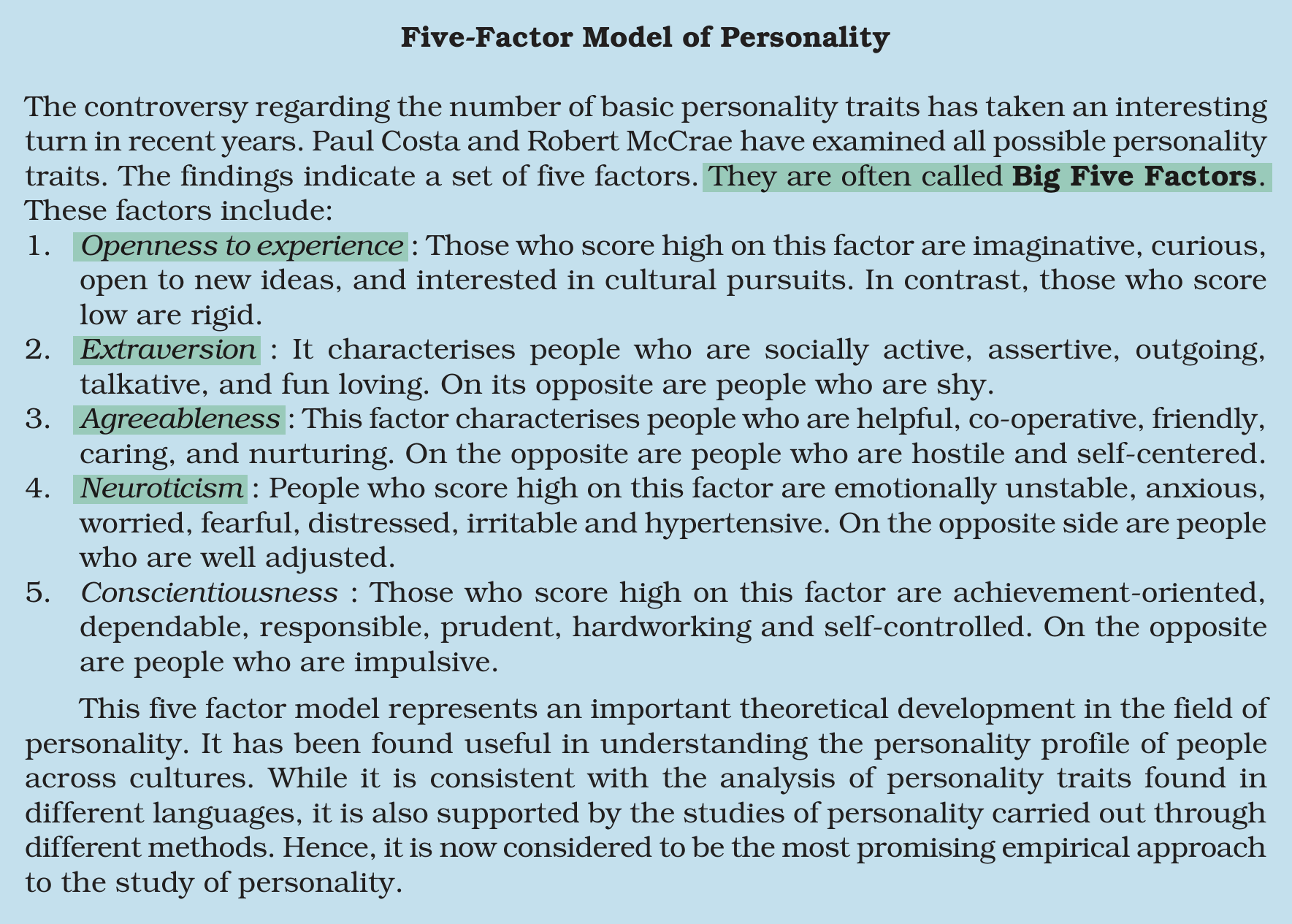
Which of the following are NOT among the Big Five factors of the Five-Factor Model of personality?
A. Openness to experience
B. Extraversion
C. Agreeableness
D. Neuroticism
E. Conscientiousness
F. Psychoticism
G. Sociability
Choose the correct answer from the options given below:
Answer & explanation
Correct answer: option 2
The correct answer is Option (2) → F and G only
(A) Openness to experience — Incorrect. Openness to experience is itself one of the five factors, so it does not stand outside that set. People who score high on it are imaginative, curious and interested in cultural pursuits.
(B) Extraversion — Incorrect. Extraversion is one of the five factors itself, so counting it among the names left out of the model reverses its standing. People who score high on it are socially active, assertive, outgoing, talkative and fun loving.
(C) Agreeableness — Incorrect. Agreeableness belongs to the five factors, not to the traits standing outside the model, so listing it as excluded mixes up the two groups. People who score high on it are helpful, co-operative, friendly, caring and nurturing.
(D) Neuroticism — Incorrect. Treating Neuroticism as outside the model reverses its place: it is one of the five factors, not an extra trait beside them. People who score high on it are emotionally unstable, anxious, worried, fearful and irritable.
(E) Conscientiousness — Incorrect. Conscientiousness is one of the five factors, so naming it as a trait that does not belong confuses the model's own factors with traits from elsewhere. People who score high on it are achievement-oriented, dependable, responsible, prudent and hardworking.
(F) Psychoticism — Correct. Psychoticism comes from Eysenck's third dimension, proposed in a later work. A person who scores high on it tends to be hostile, egocentric and antisocial.
(G) Sociability — Correct. Sociability is the other side of that same Eysenck dimension, Psychoticism vs. Sociability, which interacts with his two earlier dimensions.
NCERT (2026-27):
|