Since physisorption arises mainly because of van der Waals forces, it means adsorption is: (pick the incorrect option)
Answer & explanation
Correct answer: option 4
The correct answer is Option (4) → Enthalpy dependent
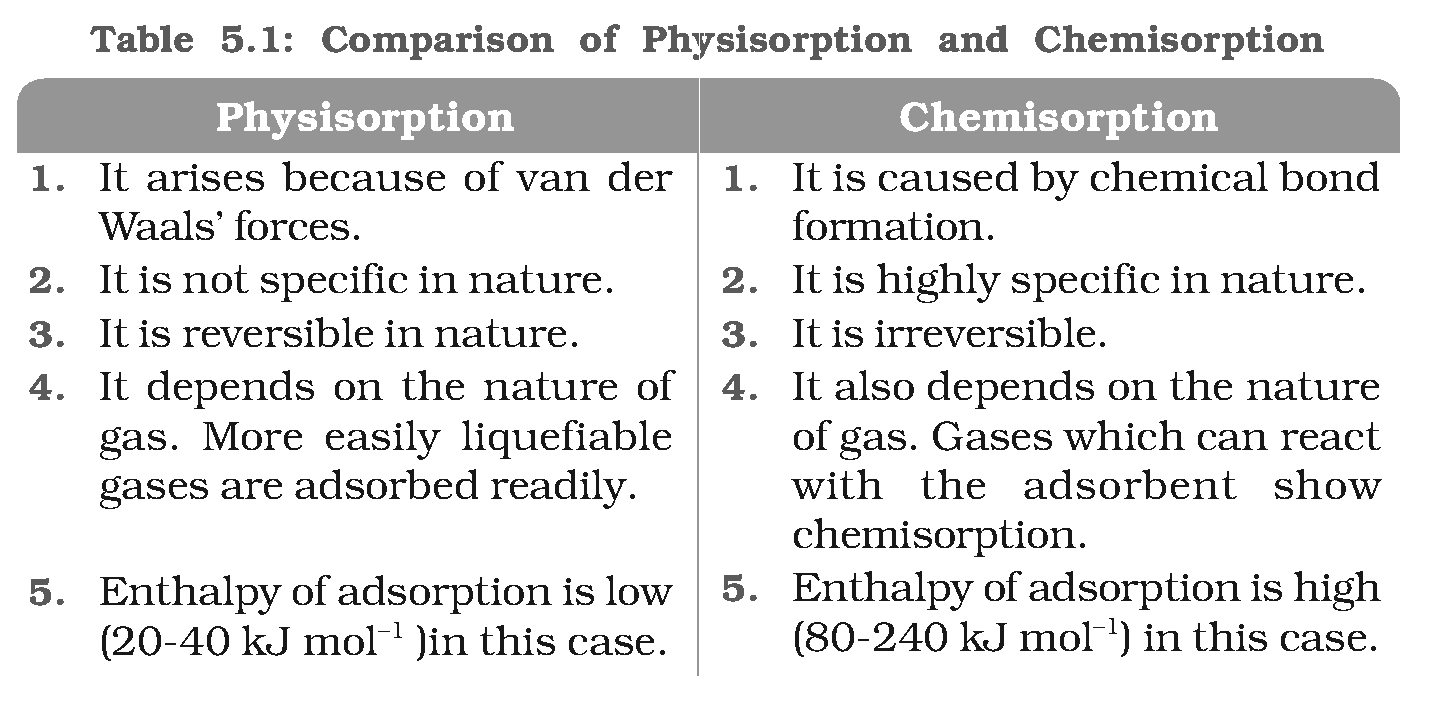
In physisorption the gas molecules are held on the surface by weak van der Waals forces. All its characteristic properties follow from this: the forces are universal, so it is not specific; they are weak and easily overcome, so it is reversible; they act between the molecules too, so several layers can build up (multimolecular); and very little energy is released, so the enthalpy of adsorption is low (20–40 kJ mol−1).
Option (1) Non-specific in nature — A property of physisorption. Any gas is adsorbed on any solid to some extent, because van der Waals forces act between all molecules.
Option (2) Reversible in nature — A property of physisorption. Lowering the pressure or raising the temperature removes the adsorbed gas easily.
Option (3) Multimolecular in layer — A property of physisorption. Under high pressure, multimolecular layers form on the adsorbent.
Option (4) Enthalpy dependent — Not a property of physisorption. The weak forces give a small enthalpy change (20–40 kJ mol−1); a large enthalpy change from bond formation belongs to chemisorption.
Note: This question is from the pre-rationalised NCERT book (2022-23). The topic is not there in the latest NCERT book (2026-27), and it is also out of the CUET 2026 syllabus.
NCERT (Pre-rationalised edition, 2022-23):
Types of Adsorption – …