Match List-I with List-II:
| List-I Terms | List-II Meanings | ||
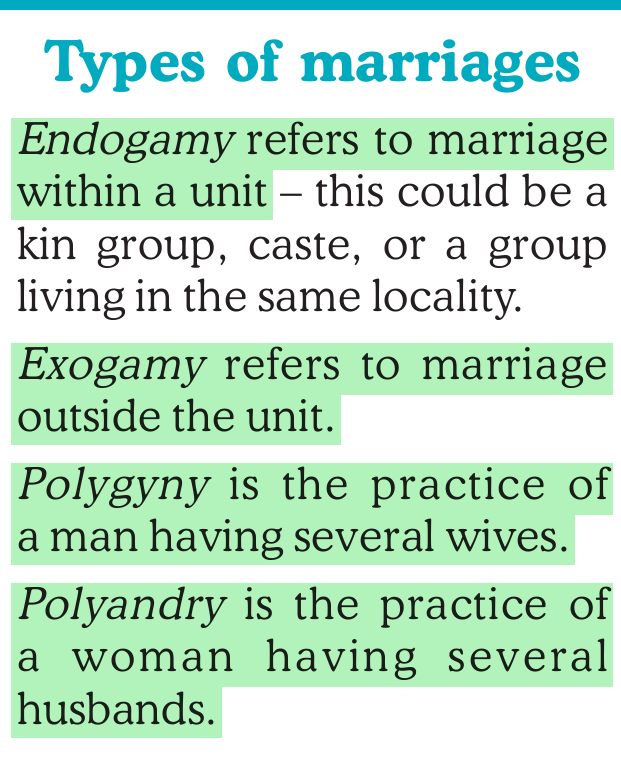
| (A) | Endogamy | (I) | Marriage within a unit |
| (B) | Exogamy | (II) | The practice of a man having several wives |
| (C) | Polygyny | (III) | Marriage outside the unit |
| (D) | Polyandry | (IV) | The practice of a woman having several husbands |
Answer & explanation
Correct answer: option 2
The correct answer is Option (2) → (A)-(I), (B)-(III), (C)-(II), (D)-(IV)
(A) Endogamy — this matches (I) Marriage within a unit. The unit could be a kin group, caste, or a group living in the same locality.
(B) Exogamy — this matches (III) Marriage outside the unit. The word literally means marrying outside; daughters of high-status families were married into families outside the kin.
(C) Polygyny — this matches (II) The practice of a man having several wives. One husband has more than one wife.
(D) Polyandry — this matches (IV) The practice of a woman having several husbands. One wife has more than one husband.
Note: A same/similar question was asked in CUET (UG) in the papers below.
| 2026 | 2025 | 2024 | 2023 | 2022 |
| 23-05 S2* | 28-05 S1 | – | 05-06 S3 09-06 S3* | – |
* A similar question.
NCERT (2026-27): “2.3 Rules of marriage … While sons were important for the continuity of the patrilineage, daughters were viewed rather differently within this framework. They had no claims to the resources of the household. At the same time, marrying them into families outside the kin was considered desirable. This system, called exogamy (literally, marrying outside), meant that the lives of young girls and women belonging to families that claimed high status were often carefully regulated to ensure that they were married at the ‘right’ time and to the ‘right’ person. This gave rise to the belief that kanyadana or the gift of a daughter in marriage was an important religious duty of the father.…”
|