
Which of the following is true for a paramagnetic substance?
Answer & explanation
Correct answer: option 3
The correct answer is Option (3) → \( \mu_r\gt 1 \)
The relative permeability of a material is \( \mu_r=1+\chi \), where \( \chi \) is its magnetic susceptibility. A paramagnetic substance has \( \chi \) small and positive.
Option (1) \( \mu_r=1 \) — Incorrect. This means \( \chi=0 \), as for vacuum, which is not magnetised at all. A paramagnetic substance does get weakly magnetised along the applied field.
Option (2) \( \mu_r=0 \) — Incorrect. This is perfect diamagnetism (\( \chi=-1 \)), shown by superconductors, which expel the magnetic field completely.
Option (3) \( \mu_r\gt 1 \) — Correct. With \( \chi \) small and positive, \( \mu_r \) is slightly greater than 1 (\( 1\lt\mu_r\lt1+\varepsilon \)). So the field inside the substance is slightly stronger.
Option (4) \( \mu_r=\infty \) — Incorrect. No material has an infinite permeability. Even a ferromagnetic substance, which is strongly magnetised, has a large but finite \( \mu_r \) (\( \mu_r\gg1 \)).
NCERT (2026-27):
Magnetisation and Magnetic Intensity – “… where μr = 1 + χ, is a dimensionless quantity called the relative magnetic permeability of the substance.”
Magnetic Properties of Materials – “… In terms of the susceptibility χ, a material is diamagnetic if χ is negative, para- if χ is positive and small, and ferro- if χ is large and positive. A glance at Table 5.2 gives one a better feeling for these materials. Here ε is a small positive number introduced to quantify paramagnetic materials.”
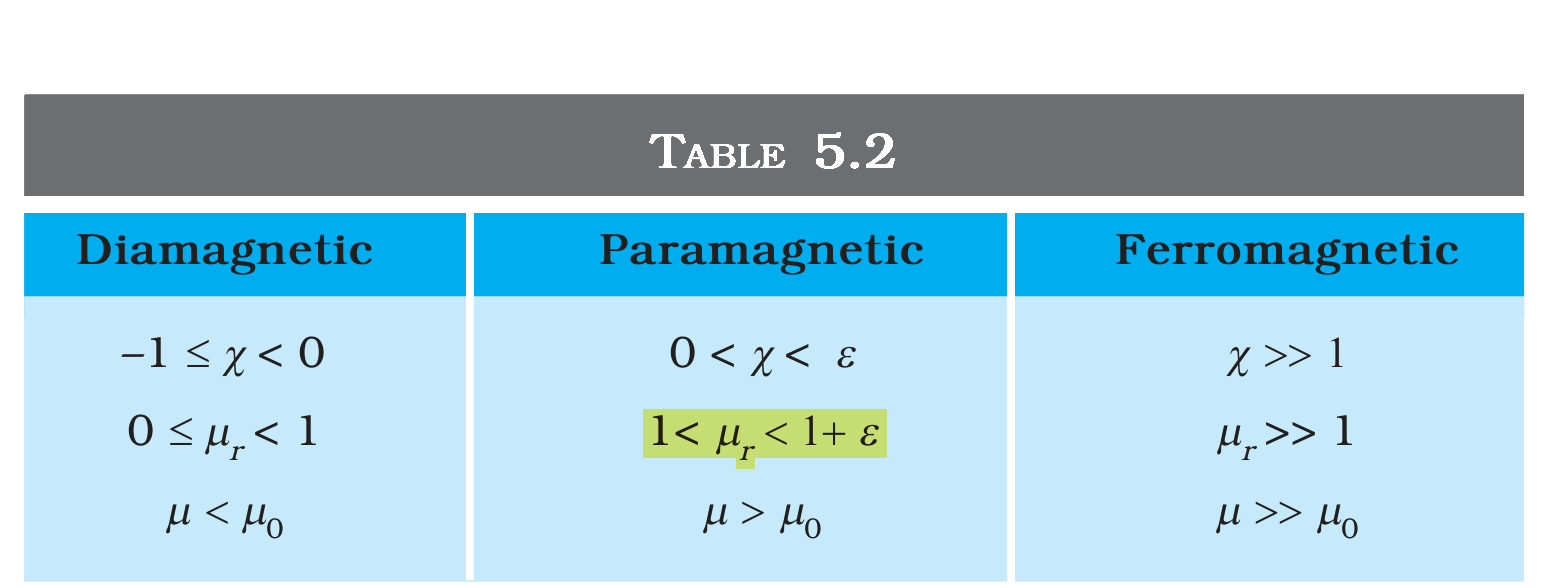
Table 5.2