
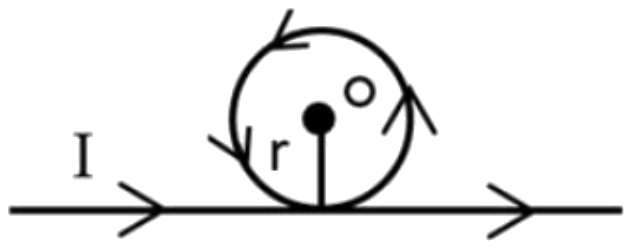
A long insulated copper wire carrying current \(I\) is given an almost circular bend of radius \(r\) as shown in the figure. The magnetic field at the center \(O\) is
Answer & explanation
Correct answer: option 3
The correct answer is Option (3) → \(\displaystyle\frac{\mu_0 I}{2r}\left(1+\frac{1}{\pi}\right)\) normally out of the paper
The field at O is the sum of the fields of the long straight wire and the circular loop; the direction of each is found with the right-hand rule.
The straight wire runs along the bottom of the loop, at distance r from the centre O:
\( \displaystyle B_{\mathrm{wire}} = \frac{\mu_0 I}{2\pi r} \)
Current flows to the right and O is above the wire, so this field is out of the paper.
The loop is a full circle of radius r:
\( \displaystyle B_{\mathrm{loop}} = \frac{\mu_0 I}{2r} \)
The arrows show the current going round the loop anticlockwise, so this field is also out of the paper. The two fields add.
\( \displaystyle B = \frac{\mu_0 I}{2r} + \frac{\mu_0 I}{2\pi r} \)
\( \displaystyle B = \frac{\mu_0 I}{2r}\left(1 + \frac{1}{\pi}\right) \text{, normally out of the paper} \)