
From the top of a 10 m high building, the angle of elevation of the top of a tower is 60° and the angle of depression of the foot of the tower is 45°. What is the height of the tower? (Take \(\sqrt{3}\) = 1.73)
Answer & explanation
Correct answer: option 1
The correct answer is Option (1) → 27.3 m
A horizontal line from the top of the building, B, meets the tower at C and splits it into two parts: CE below, equal to the building’s height, and AC above. The angle of depression gives the distance between the building and the tower, and the angle of elevation then gives AC.
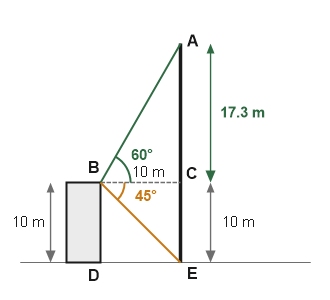
Distance between the building and the tower (triangle BCE, angle 45°):
\(\displaystyle \tan45^\circ=\frac{CE}{BC}\), and CE \(=10\) m
\(\displaystyle 1=\frac{10}{BC}\), so BC \(=10\) m
Part of the tower above the building (triangle BCA, angle 60°):
\(\displaystyle \tan60^\circ=\frac{AC}{BC}\), so AC \(=10\sqrt{3}=10\times1.73=17.3\) m
Height of the tower \(=\) AC + CE \(=17.3+10=27.3\) m