Answer & explanation
Correct answer: option 2
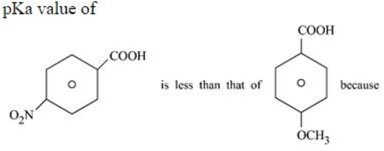
The correct answer is Option (2) → NO2 is an electron withdrawing group which decreases electron-density on ring.
A lower pKa means a stronger acid. The acid strength of a benzoic acid depends on how well the ring substituent stabilises the carboxylate ion formed on losing \( \ce{H^{+}} \).
–NO2 (in 4-nitrobenzoic acid) withdraws electrons by −I and −R effects, spreads out the negative charge of the carboxylate ion and stabilises it ⇒ stronger acid, lower pKa.
–OCH3 (in 4-methoxybenzoic acid) donates electrons by +R effect, destabilises the carboxylate ion ⇒ weaker acid, higher pKa.
Why the other options are incorrect
Option (1) — Incorrect. –\( \ce{NO2} \) is electron withdrawing, not donating; a donating group would raise the pKa.
Option (3) — Incorrect. States the reverse; the nitro acid is the more acidic of the two.
Option (4) — Incorrect. Hyperconjugation needs C–H bonds next to the ring, which neither substituent provides; it does not decide this order.
NCERT (2026-27 edition):
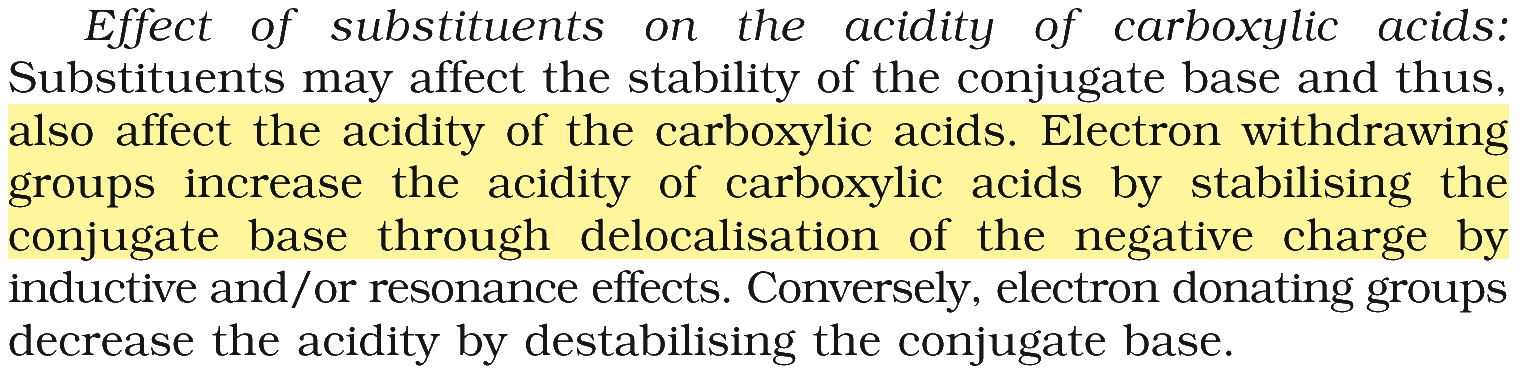
Effect of Substituents on the Acidity of Carboxylic Acids