
CUETMOCK
  • Pricing
  • Mentors
Log inStart freeStart free mocks→

First test, then trust

Try a free CUET mock test.

Join 5,00,000+ students who rehearsed exam day on the exact NTA screen before sitting CUET. On the web and on Android.

Start free mocks →Get the Android app
CUETMOCK

India's #1 CUET Mock Test Platform. Original NCERT-based questions on the exact NTA exam screen — trusted by 5,00,000+ students since CUET 2022.

Get it onGoogle PlayScan to download the CUETMOCK app

Mock tests

  • CUET mock test series
  • Browse all papers
  • Commerce mocks
  • Humanities (Arts) mocks
  • Science mocks
  • Languages & GAT mocks
  • Free practice questions
  • Pricing

Resources

  • CUET exam guide
  • CUET syllabus
  • Universities accepting CUET
  • Expert blogs
  • News & notifications
  • Webinars & counselling
  • CUET score calculator
  • How we estimate your rank
  • FAQs

Company

  • About us
  • Our leadership & team
  • Our toppers
  • Mentors
  • For schools
  • Contact us
  • Terms
  • Privacy
  • Refund policy

Talk to us

+91 7696 6630 56info@cuetmock.comWhatsApp us

Our other platforms

  • JEE Mock — For IIT-JEE aspirants
  • NEET Mock — For NEET aspirants

Newsletter

Exam updates, study material and offers — no spam.

© 2026 NYC Ventures Pvt. Ltd.

701-702, Royal Business Park, Zirakpur, Punjab - 140603

  • Terms of use
  • Privacy policy
  • Refund policy
  • Contact us

iCUETMOCK is an independent preparation platform, not affiliated with the National Testing Agency (NTA). Always check exam details on the official NTA website.

  • Home
  • Mock tests
  • CUET guide
  • Pricing
  • Log in
Home/Practice questions/History
HistoryAncient India: Kinship, Caste and Class

In the illustration from a Persian translation of the Mahabharata, wh…

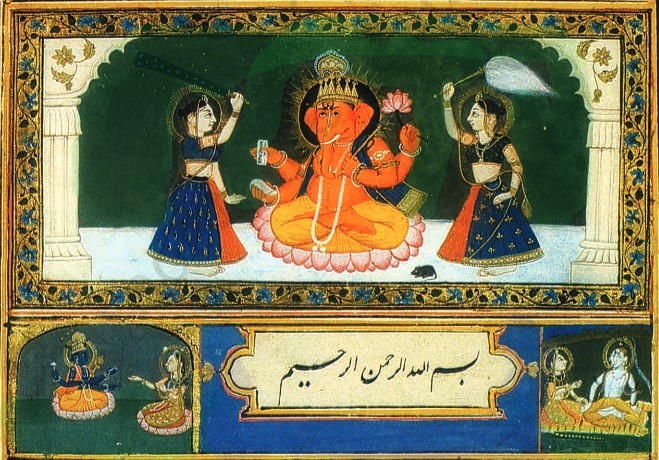
In the illustration from a Persian translation of the Mahabharata, who is depicted as the scribe transcribing the text dictated by Vyasa?

Answer & explanation+

Correct answer: option 1

The correct answer is Option (1) → Lord Ganesha

The illustration, from a Persian translation of c. 1740-50, shows Lord Ganesha as the scribe, since by tradition Vyasa dictated the text to him.

NCERT (2026-27): “6.2 Author(s) and dates …
Fig. 3.9 Lord Ganesha the scribe”

“dictated the text to the deity. This illustration is from a Persian translation of the Mahabharata, c. 1740-50.”

Advertisement

Practise more on Ancient India: Kinship, Caste and Class

Chapter-wise mocks on the real NTA exam screen, with solutions and your rank. Your first mocks are free.

Start free mocks →

Advertisement

Next questions

  1. Superconductors have-Chemistry · Physical: Electro Chemistry
  2. Which of the following shortcut key is used to move the cursor one word to the left in MS=Word 365 ?General Aptitude Test · General Knowledge
  3. What is the death rate if there are 800 individuals alive at the beginning of the 1-year age interval and 200 individuals die during this i…Biology · Organisms and Populations
  4. Arrange Freud's Psychosexual stages of development in correct order: (A) Oral stage(B) Anal stage(C) Genital stage(D) Phallic stage(E) Late…Psychology · Self and Personality
  5. What is the main purpose of studying population growth and changes in population density?Biology · Organisms and Populations
  6. Which of the following are correct about t-test statistics? (A) The mean of t-test distribution is 0.(B) It depends on the degrees of freed…Applied Maths. Section B2 · Inferential Statistics
  7. Which act made the British government suppress political activities and up to 2 hours without any trial Allowed to detain political prisone…General Aptitude Test · General Knowledge
  8. Select the appropriate pair of words to fill in the blanks:With a clever trap in the final round, fourteen-year-old Ishaan managed to _____…English · Fill Blanks
  9. Which of the following is a classification of Rain Fed Farming?Geography · India-People and Economy: Land resources and Agriculture
  10. Fill in the blank with the correct word from the options given below:- Peculiar habits of a person are called _____.English · One Word