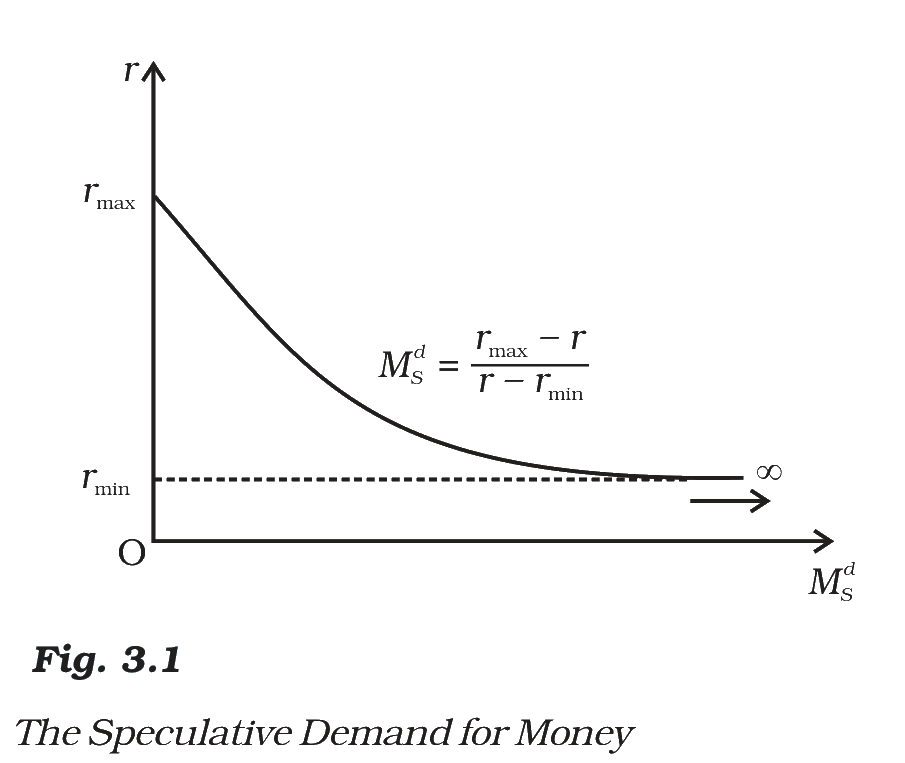
The figure below shows the speculative demand for money (MdS) at different rates of interest (r).
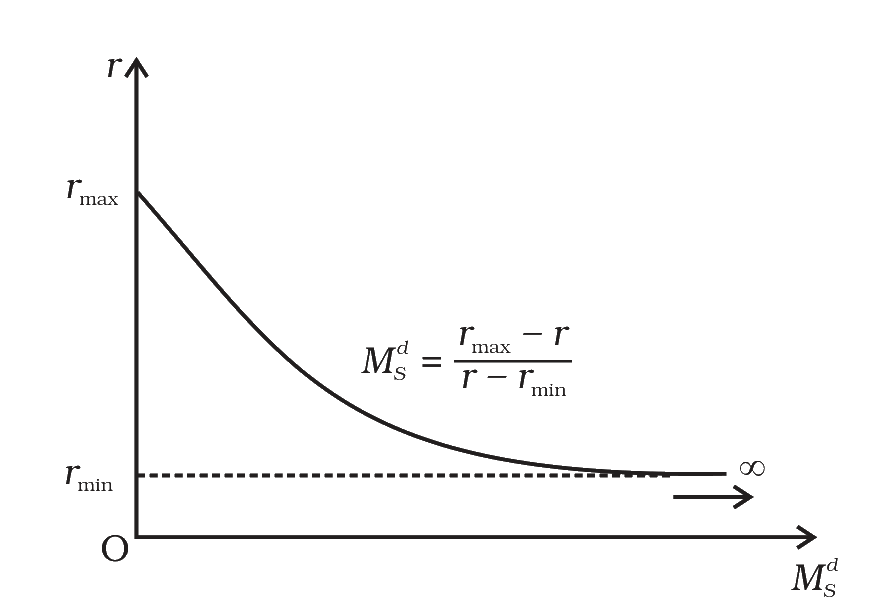
As r falls from rmax towards rmin, the speculative demand for money:
Answer & explanation
Correct answer: option 4
The correct answer is Option (4) → rises from zero towards infinity, as more people expect the rate of interest to rise
The curve slopes down from rmax to rmin. So as r falls, the speculative demand for money rises, from zero at rmax towards infinity at rmin.
Option (1) falls from infinity to zero, as people expect capital gains from bonds — Incorrect. This happens when r rises towards rmax.
Option (2) rises from zero towards infinity, as more people expect bond prices to rise — Incorrect. The direction is right, but the reason is wrong. People expect the rate to rise, so they expect bond prices to fall.
Option (3) stays the same, as speculative demand depends only on income — Incorrect. Income decides the transaction demand for money. Speculative demand depends on the rate of interest.
Option (4) rises from zero towards infinity, as more people expect the rate of interest to rise — Correct. People fear a capital loss on bonds, so they hold money.
NCERT (2026-27): “The Speculative Motive … When the interest rate is very high everyone expects it to fall in future and hence anticipates capital gains from bond-holding. Hence people convert their money into bonds. Thus, speculative demand for money is low. When interest rate comes down, more and more people expect it to rise in the future and anticipate capital loss. Thus they convert their bonds into money giving rise to a high speculative demand for money. Hence speculative demand for money is inversely related to the rate of interest. … where r is the market rate of interest and rmax and rmin are the upper and lower limits of r, both positive constants. It is evident from the above equation that as r decreases from rmax to rmin, the value of MdS increases from 0 to ∞. …”
|