Match List-I with List-II
| List-I | List-II |
| (A) \( M_1 \) | (I) \( M_1 \) + Net time deposits of commercial banks |
| (B) \( M_3 \) | (II) Assets - Liabilities |
| (C) Net Worth | (III) 1/CRR |
| (D) Money Multiplier | (IV) Currency + Demand Deposit |
Choose the correct answer from the options given below:
Answer & explanation
Correct answer: option 2
The correct answer is Option (2) → (A)-(IV), (B)-(I), (C)-(II), (D)-(III)
M1 and M3 are measures of the money supply. Net worth comes from a bank’s balance sheet, and the money multiplier shows how far banks can create money.
| List-I | List-II | Reason |
|---|---|---|
| (A) \( M_1 \) | (IV) Currency + Demand Deposit | It is the most liquid measure, the easiest to use for transactions: currency with the public plus demand deposits held in banks. |
| (B) \( M_3 \) | (I) \( M_1 \) + Net time deposits of commercial banks | It is broad money, which adds time deposits to \( M_1 \). |
| (C) Net Worth | (II) Assets - Liabilities | It is what is left of a bank’s assets after its liabilities are paid. |
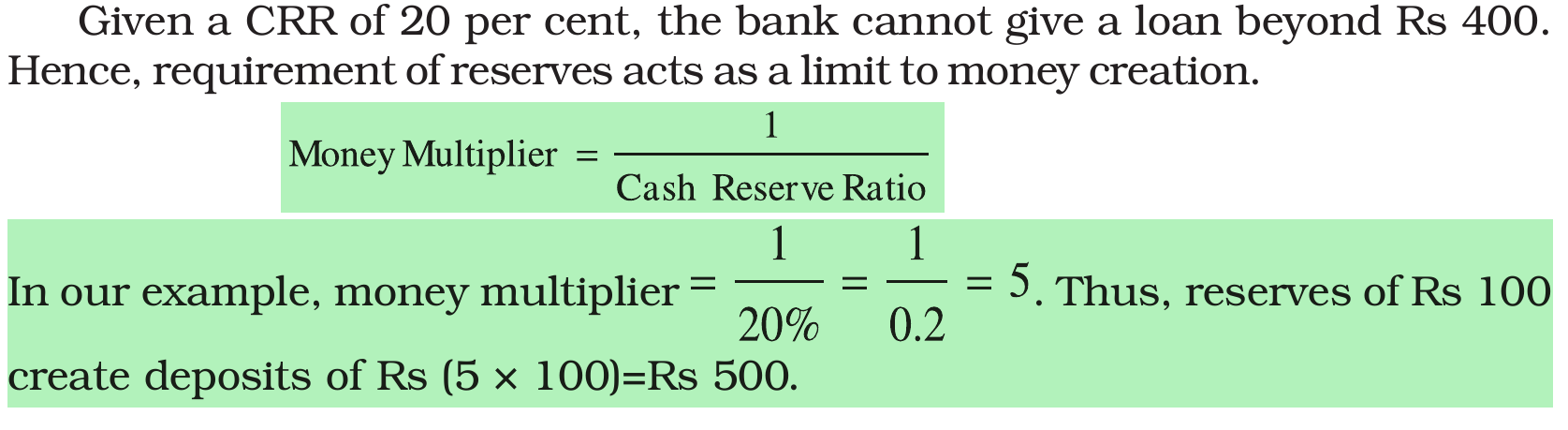
| (D) Money Multiplier | (III) 1/CRR | The cash reserve ratio (CRR) is the share of deposits that banks must keep as reserves, and this limits deposits. With a CRR of 20 per cent, 1/0.2 = 5, so Rs. 100 of reserves creates Rs. 500 of deposits. |
NCERT (2026-27): “Legal Definitions: Narrow and Broad Money … RBI publishes figures for four alternative measures of money supply, viz. M1, M2, M3 and M4. They are defined as follows … The accounting rule states that both sides of the account must balance. Hence if assets are greater than liabilities, they are recorded on the right hand side as Net Worth.
|