
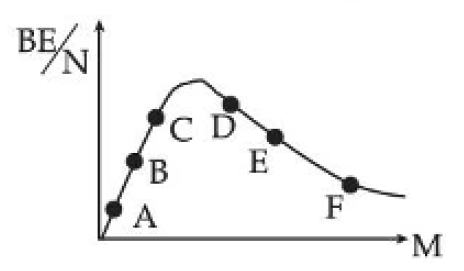
In the graph, Binding energy per nucleon \( \left(BE/N\right) \) against nuclear mass (M) is plotted. A, B, C, D, E, F correspond to different nuclei. Consider following four reactions where Q is the energy released. In which reaction Q is positive?
(A) \( C \rightarrow A + B + Q \)
(B) \( F \rightarrow D + E + Q \)
(C) \( A + B \rightarrow C + Q \)
(D) \( D + E \rightarrow F + Q \)
Choose the correct answer from the options given below:
Answer & explanation
Correct answer: option 4
The correct answer is Option (4) → (B) and (C) only
Energy is released in a nuclear reaction when the products are more tightly bound than the reactants, that is, when the binding energy per nucleon increases. On the graph \( BE/N \) rises from A to C and falls from D to F.
(A) \( C \rightarrow A + B + Q \) — Incorrect. A light nucleus splits into lighter ones, moving down the rising part of the curve, so Q is negative.
(B) \( F \rightarrow D + E + Q \) — Correct. This is fission of a heavy nucleus: F has a lower \( BE/N \) than D and E, so the products are more tightly bound and Q is positive.
(C) \( A + B \rightarrow C + Q \) — Correct. This is fusion of light nuclei: C has a higher \( BE/N \) than A and B, so energy is released and Q is positive.
(D) \( D + E \rightarrow F + Q \) — Incorrect. The product F lies lower on the falling part of the curve, so Q is negative.
NCERT (2026-27):
Nuclear Binding Energy – “… (iii) A very heavy nucleus, say A = 240, has lower binding energy per nucleon compared to that of a nucleus with A = 120. Thus if a nucleus A = 240 breaks into two A = 120 nuclei, nucleons get more tightly bound. This implies energy would be released in the process. … (iv) Consider two very light nuclei (A ≤ 10) joining to form a heavier nucleus. The binding energy per nucleon of the fused heavier nuclei is more than the binding energy per nucleon of the lighter nuclei. … Again energy would be released in such a process of fusion.”