
CUETMOCK
  • Pricing
  • Mentors
Log inStart freeStart free mocks→

First test, then trust

Try a free CUET mock test.

Join 5,00,000+ students who rehearsed exam day on the exact NTA screen before sitting CUET. On the web and on Android.

Start free mocks →Get the Android app
CUETMOCK

India's #1 CUET Mock Test Platform. Original NCERT-based questions on the exact NTA exam screen — trusted by 5,00,000+ students since CUET 2022.

Get it onGoogle PlayScan to download the CUETMOCK app

Mock tests

  • CUET mock test series
  • Browse all papers
  • Commerce mocks
  • Humanities (Arts) mocks
  • Science mocks
  • Languages & GAT mocks
  • Free practice questions
  • Pricing

Resources

  • CUET exam guide
  • CUET syllabus
  • Universities accepting CUET
  • Expert blogs
  • News & notifications
  • Webinars & counselling
  • CUET score calculator
  • How we estimate your rank
  • FAQs

Company

  • About us
  • Our leadership & team
  • Our toppers
  • Mentors
  • For schools
  • Contact us
  • Terms
  • Privacy
  • Refund policy

Talk to us

+91 7696 6630 56info@cuetmock.comWhatsApp us

Our other platforms

  • JEE Mock — For IIT-JEE aspirants
  • NEET Mock — For NEET aspirants

Newsletter

Exam updates, study material and offers — no spam.

© 2026 NYC Ventures Pvt. Ltd.

701-702, Royal Business Park, Zirakpur, Punjab - 140603

  • Terms of use
  • Privacy policy
  • Refund policy
  • Contact us

iCUETMOCK is an independent preparation platform, not affiliated with the National Testing Agency (NTA). Always check exam details on the official NTA website.

  • Home
  • Mock tests
  • CUET guide
  • Pricing
  • Log in
Home/Practice questions/General Aptitude Test
General Aptitude TestQuantitative ReasoningData Interpretation & Stats

The Bar Graph shows the Profit (Rupees in Lakhs) earned by two compan…

The Bar Graph shows the Profit (Rupees in Lakhs) earned by two companies P and Q during the period 2011 to 2017.
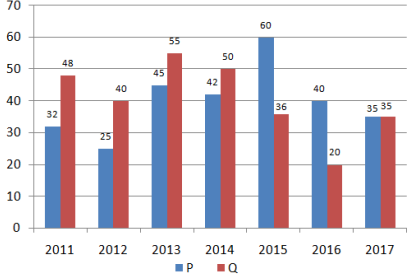
The ratio of average profit during the given period for Company P to Company Q is:

Answer & explanation+

Correct answer: option 4

Average profit of P  :  Average profit of Q

\(\frac{32+25+45+42+60+40+35 }{7}\) : \(\frac{ 48+40+55+50+36+20+35}{7}\) 

\(\frac{ 279 }{7}\) : \(\frac{ 284}{7}\)

           279             :         284


Advertisement

Practise more on Quantitative Reasoning

Chapter-wise mocks on the real NTA exam screen, with solutions and your rank. Your first mocks are free.

Start free mocks →

Advertisement

Next questions

  1. The torque acting on a magnet of magnetic length 8 cm and pole strength 20 A m placed in a magnetic field of 3 × 10^-5 T at an angle of π/6…Physics · Magnetism and Matter
  2. Who was the ‘Pal’ of the radical trio of leaders popularly called ‘Lal-Bal-Pal’?General Aptitude Test · General Knowledge
  3. In the Mughal Empire, who was responsible for supervising the fiscal system of the empire?History · Medieval India: Peasants, Zamindars and the State
  4. Which letter-cluster will replace the question mark (?) to complete the given series? GSAV, JPER, ?, PJMJ, SGQFGeneral Aptitude Test · General Ability
  5. The coins in the glass case helped scholars read the script used in the inscriptions of the northwest. These coins were issued by which rul…History · Ancient India: Kings, Farmers and Towns
  6. Who is the author of the book ‘The Indian Navy@75 Reminiscing the Voyage’?General Aptitude Test · Current Affairs
  7. "Another method he wants to use is the online system of stock exchange." Identify the method of floatation used in these lines.Business Studies · Financial Markets
  8. A trapezium plate having two parallel sides of length 15 cm and 9 cm. and distance between them is 6 cm. Copper plating is to be done on th…General Aptitude Test · Quantitative Reasoning
  9. The situationist perspective views human behaviour relatively more as a result of the influence of:Psychology · Variations in Psychological Attributes
  10. Assertion (A): Gifted children do not require special attention and different educational programmes to reach their full potential.Reason (…Psychology · Variations in Psychological Attributes