CUETMOCK
  • Pricing
  • Mentors
Log inStart freeStart free mocks→

First test, then trust

Try a free CUET mock test.

Join 5,00,000+ students who rehearsed exam day on the exact NTA screen before sitting CUET. On the web and on Android.

Start free mocks →Get the Android app
CUETMOCK

India's #1 CUET Mock Test Platform. Original NCERT-based questions on the exact NTA exam screen — trusted by 5,00,000+ students since CUET 2022.

Get it onGoogle PlayScan to download the CUETMOCK app

Mock tests

  • CUET mock test series
  • Browse all papers
  • Commerce mocks
  • Humanities (Arts) mocks
  • Science mocks
  • Languages & GAT mocks
  • Free practice questions
  • Pricing

Resources

  • CUET exam guide
  • CUET syllabus
  • Universities accepting CUET
  • Expert blogs
  • News & notifications
  • Webinars & counselling
  • CUET score calculator
  • How we estimate your rank
  • FAQs

Company

  • About us
  • Our leadership & team
  • Our toppers
  • Mentors
  • For schools
  • Contact us
  • Terms
  • Privacy
  • Refund policy

Talk to us

+91 7696 6630 56info@cuetmock.comWhatsApp us

Our other platforms

  • JEE Mock — For IIT-JEE aspirants
  • NEET Mock — For NEET aspirants

Newsletter

Exam updates, study material and offers — no spam.

© 2026 NYC Ventures Pvt. Ltd.

701-702, Royal Business Park, Zirakpur, Punjab - 140603

  • Terms of use
  • Privacy policy
  • Refund policy
  • Contact us

iCUETMOCK is an independent preparation platform, not affiliated with the National Testing Agency (NTA). Always check exam details on the official NTA website.

  • Home
  • Mock tests
  • CUET guide
  • Pricing
  • Log in
Home/Practice questions/Economics
EconomicsMacro Economics: Money and Banking

The Reserve Bank of India publishes four measures of money supply. Wh…

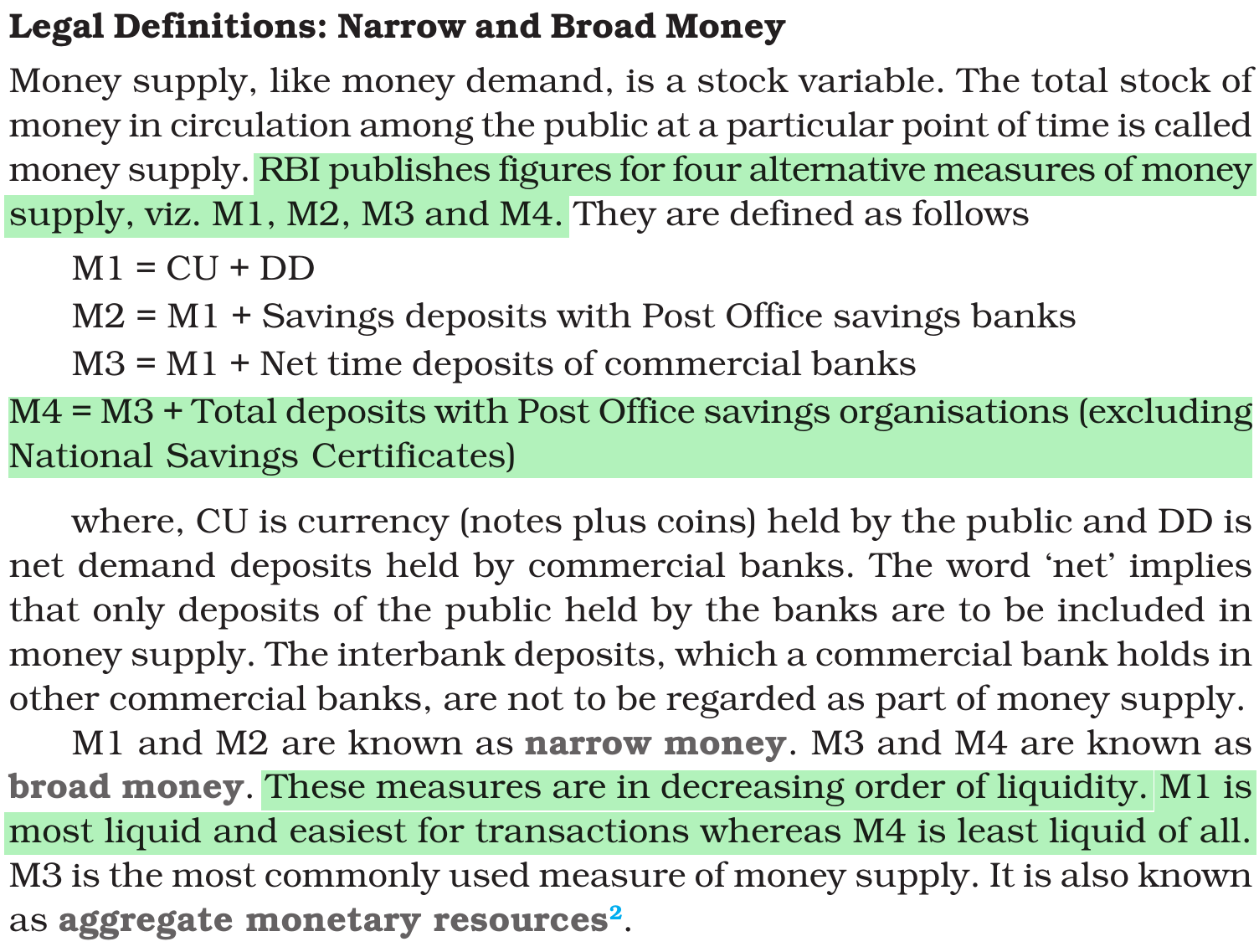
The Reserve Bank of India publishes four measures of money supply. Which one of the measures is the least liquid in them?

Answer & explanation+

Correct answer: option 4

The correct answer is Option (4) → \( M_4=M_3 \) + Total deposits with Post Office savings organisations.

The RBI’s four measures, M1 to M4, are in decreasing order of liquidity. Liquidity means how easily money can be used for transactions. M1 is the most liquid and M4 is the least liquid of all.

NCERT (2026-27): Introductory Macroeconomics — Chapter 3: Money and Banking

NCERT extract

Advertisement

Practise more on Macro Economics: Money and Banking

Chapter-wise mocks on the real NTA exam screen, with solutions and your rank. Your first mocks are free.

Start free mocks →

Advertisement

Next questions

  1. Given below are two statements:Statement I: In the Renaissance Period, demonology and superstition gained renewed importance in explaining…Psychology · Psychological Disorders
  2. If a + b = 8 and ab = 12, then the value of a^3+b^3 is :General Aptitude Test · Quantitative Reasoning
  3. Match the chemical conversion in List I to the appropriate reagent in List II List I List II A. Phenol longrightarrow Benzene I. Na_2Cr_2O_…Chemistry · Organic: Alcohols, Phenols and Ethers
  4. The general solution of the differential equation displaystyledy/dx=e^x+y , is:Maths. Section A · Differential Equations (Section A)
  5. Identify the most famous court-historian during Akbar’s reign:History · Medieval India: Peasants, Zamindars and the State
  6. A long solenoid has 800 turns per metre length of solenoid. A current of 1.6 A flows through it. The magnetic induction at the end of the s…Physics · Moving Charges and Magnetism
  7. Is the internet still evolving?English · Comprehension - (Narrative / Factual)
  8. When one mole of KMnO_4 is used for the oxidation of oxalic acid, how many moles of CO_2 will be produced?Chemistry · Inorganic: D and F Block Elements
  9. In a certain code language, 'CRUST' is written as '201921183' and 'BLAME' is written as '5131122'. How will 'PLASTIC' be written in that la…General Aptitude Test · Verbal Reasoning
  10. The equation of a curve is y=f(x). The tangents at (1, f(1)),(2, f(2)) and (3, f(3)) make angles (π)/6, (π)/3 and (π)/4 respectively with t…Maths. Section B1 · Applications of Derivatives