


CUET Preparation Today
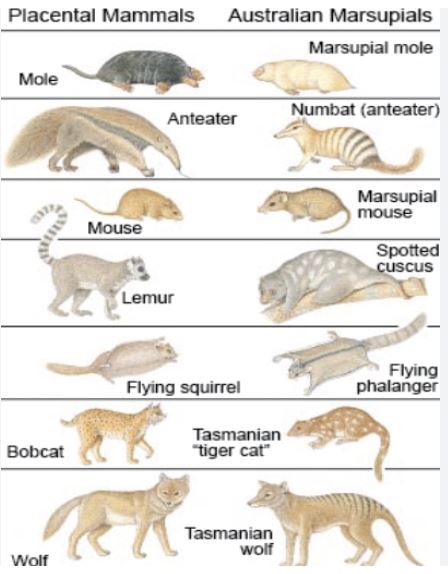
Tasmanian tiger cat is a marsupial while Bobcat is a placental mammal. This shows : |
Divergent evolution. Convergent evolution . Mimicry . None of these . |
Convergent evolution . |
The correct answer is Option (2) – Convergent evolution . The scenario described, where the Tasmanian tiger cat is a marsupial while the Bobcat is a placental mammal, exemplifies: Convergent evolution. This is because the Tasmanian tiger (also known as the thylacine, a marsupial) and the bobcat (a placental mammal) belong to different evolutionary lineages, yet they developed similar features and appearances due to adapting to similar environments and ecological roles. Convergent evolution occurs when unrelated species evolve similar traits independently, not due to shared ancestry, but because they face similar environmental pressures. A number of marsupials, each different from the other evolved from an ancestral stock, but all within the Australian island continent. When more than one adaptive radiation appeared to have occurred in an isolated geographical area (representing different habitats), one can call this convergent evolution. Placental mammals in Australia also exhibit adaptive radiation in evolving into varieties of such placental mammals each of which appears to be ‘similar’ to a corresponding marsupial (e.g., Placental Bobcat and Tasmanian tiger cat-marsupial).
Picture showing convergent evolution of Australian Marsupials and placental mammals |