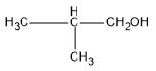
The most suitable substrates for preparation of following alcohol is
Answer & explanation
Correct answer: option 3
The correct answer is Option (3) → \( \ce{CH2O} \) + \( \ce{(CH3)2CH-MgBr} \) (methanal and isopropylmagnesium bromide)
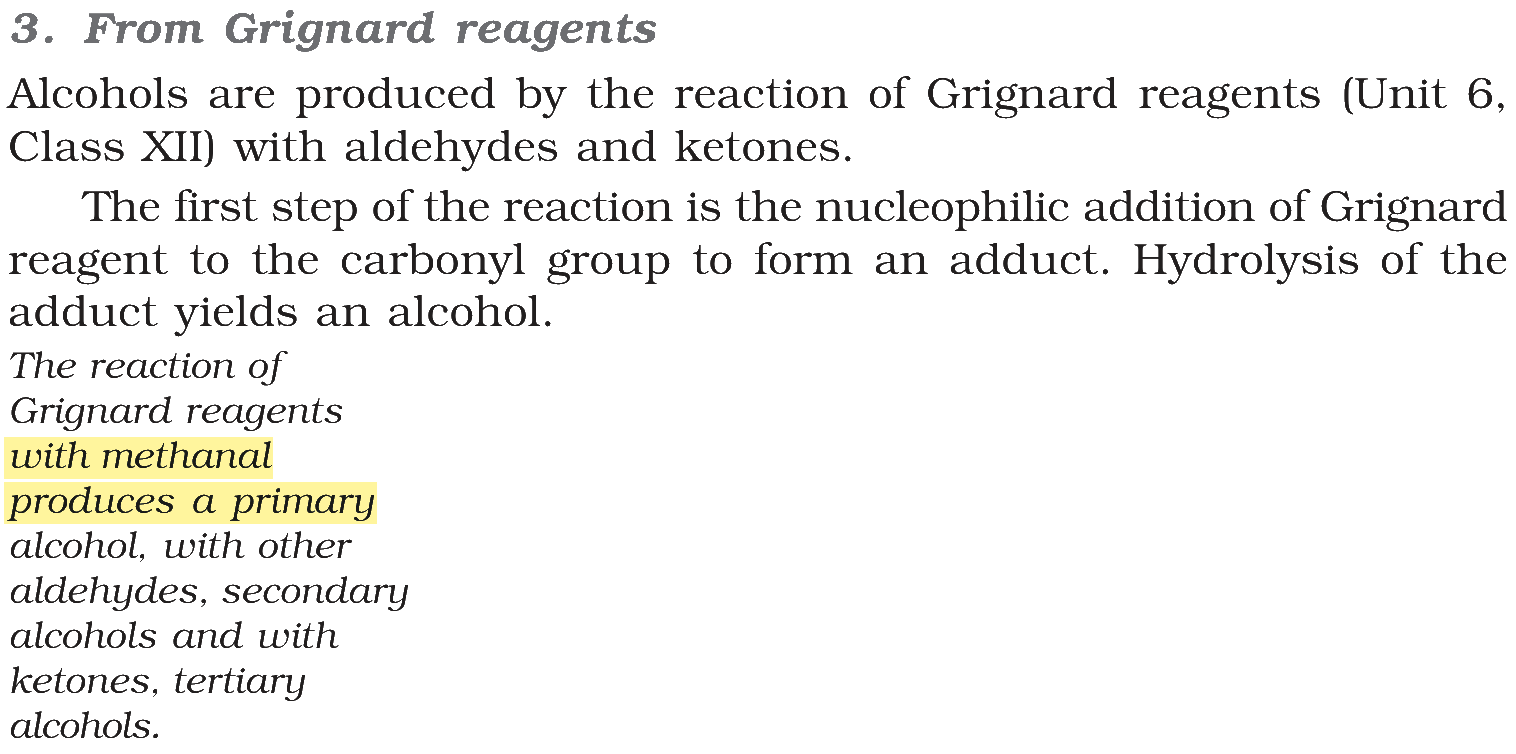
The target, \( \ce{(CH3)2CH-CH2OH} \) (2-methylpropan-1-ol), is a primary alcohol. Methanal gives a primary alcohol, so its –\( \ce{CH2OH} \) carbon must come from methanal, and the rest, the isopropyl group, from the Grignard reagent:
\( \displaystyle \ce{HCHO + (CH3)2CHMgBr} \xrightarrow{\text{dry ether}} \ce{(CH3)2CH-CH2-OMgBr} \xrightarrow{\ce{H2O}} \ce{(CH3)2CH-CH2OH + Mg(OH)Br} \)
So the most suitable substrates are methanal and isopropylmagnesium bromide.
Why the other options are incorrect
Option (1) \(CH_3CHO+CH_3CH_2MgBr\) — Incorrect. An aldehyde other than methanal gives a secondary alcohol, here butan-2-ol:
\( \displaystyle \ce{CH3CHO + CH3CH2MgBr} \xrightarrow[\text{(ii) }\ce{H2O}]{\text{(i) dry ether}} \ce{CH3-CH(OH)-CH2CH3} \)
Option (2) \(CH_3COCH_3+CH_3MgBr\) — Incorrect. A ketone gives a tertiary alcohol, here 2-methylpropan-2-ol:
\( \displaystyle \ce{CH3COCH3 + CH3MgBr} \xrightarrow[\text{(ii) }\ce{H2O}]{\text{(i) dry ether}} \ce{(CH3)3C-OH} \)
Option (4) \(CH_3CH_2CHO+CH_3MgBr\) — Incorrect. This also gives the secondary alcohol butan-2-ol:
\( \displaystyle \ce{CH3CH2CHO + CH3MgBr} \xrightarrow[\text{(ii) }\ce{H2O}]{\text{(i) dry ether}} \ce{CH3CH2-CH(OH)-CH3} \)
NCERT (2026-27 edition):
From Grignard Reagents