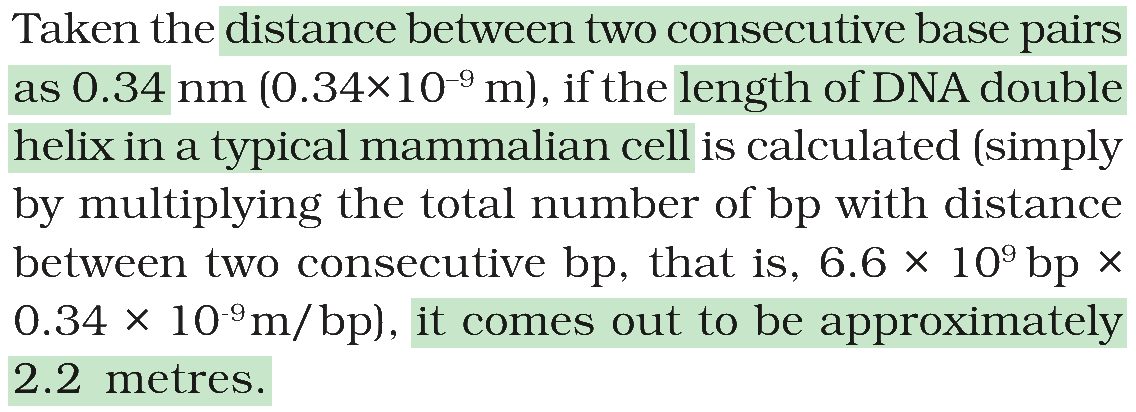
Calculate the length of DNA double helix in a typical mammalian cell, considering the total number of base pairs as 6.6 × 10⁹ bp and the distance between two consecutive base pairs as 0.34 × 10⁻⁹ m.
Answer & explanation
Correct answer: option 2
The correct answer is Option (2) → Approximately 2.2 metres
The length of a DNA double helix is found by multiplying the total number of base pairs (bp) by the distance between two consecutive base pairs.
\( \displaystyle \text{Length} = 6.6\times10^{9}\ \text{bp} \times 0.34\times10^{-9}\ \text{m/bp} \)
\( \displaystyle = (6.6\times0.34)\times(10^{9}\times10^{-9})\ \text{m} \)
\( \displaystyle = 2.244\ \text{m} \approx 2.2\ \text{m} \)
So the DNA of one human cell is about 2.2 metres long. This is far greater than the size of the nucleus, which is about 10−6 m. The other values, 3.4, 4.2 and 6.6 metres, do not come out of this multiplication.
NCERT Extract:
Packaging of DNA Helix – …